
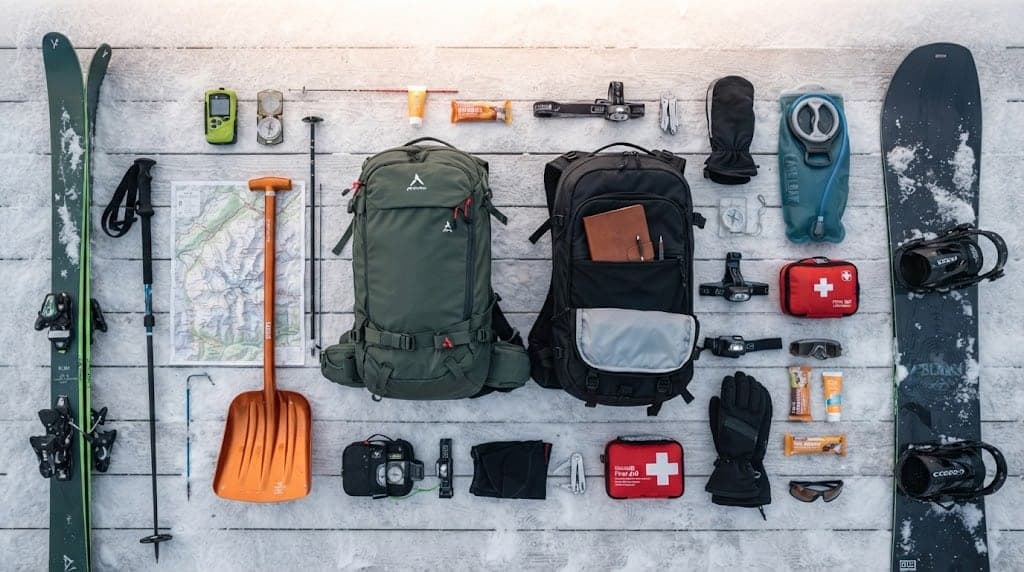
Almost every "what to take to the snow" list makes the same mistake: it lumps your sandwich and an avalanche transceiver into one pile, as if they were the same kind of decision. They aren't. Skiing on piste and going off-piste are two different activities with two different lists, and mixing them means some people carry gear they'll never use while others feel confident believing they're equipped. Here are both, kept apart.
In short: for a day on piste everything fits in your pockets: a charged phone, water, something to eat, sunscreen, goggles and spare gloves. For going off-piste you need a transceiver, an aluminium shovel and a probe, plus the training to use them — and that isn't a shopping list, it's a course.
Two lists, not one
The difference isn't one of quantity, it's one of nature.
On piste you're inside a controlled area: there are patrollers, the lifts return you to the base regularly and you're never far from a building. What you carry is for your comfort and for sorting out minor setbacks.
Off-piste none of that applies. The gear you carry is the only thing standing between an accident and its consequences, and it only works if you know how to use it and if the people with you do too. A transceiver in the pack of someone who has never done a search is dead weight.
This article covers both lists, but it's worth saying plainly from the start: if your plan includes leaving the marked area, the first purchase isn't equipment, it's training.
For a day on piste
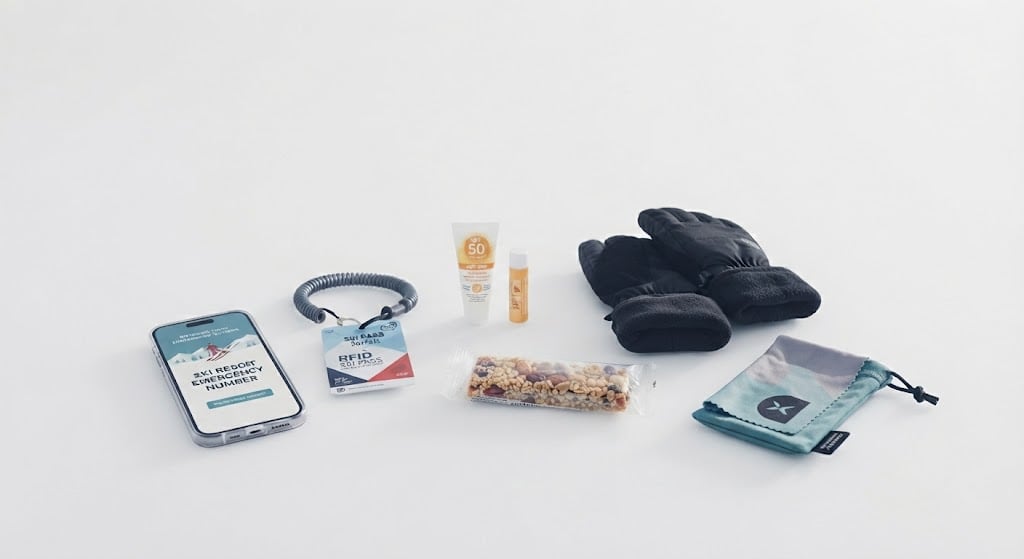
This is the list that serves 95% of people, and the striking thing is how short it is. Most of it fits in your jacket pockets, with no pack at all.
- A charged phone, with the resort's emergency number saved.
- Your lift pass, in your sleeve pocket.
- Water. People drink less than they should because it isn't hot, but at altitude and with effort you dehydrate just the same.
- Something to eat: fruit, nuts, a bar. Mid-morning on snow will floor anyone who had a light breakfast.
- Sunscreen and lip balm, to reapply. It's the most forgotten thing and the most noticed the next day. Why it matters so much here is in the sun protection guide.
- Spare gloves, especially with children. Soaked gloves end the day early.
- A spare buff or neck gaiter, for the same reason.
- Your goggle cloth, in its pouch.
And not much else. If that doesn't fit on you, then yes, you need a small pack; which one is in the backpack guide.
Your phone, which is your safety equipment on piste
It deserves its own section because it's what you'll actually use if something happens, and it fails exactly when you need it.
- Cold drains the battery very fast. A phone showing 60% can shut down within minutes below freezing. Carry it in an inside pocket, against your body, not in your jacket's outer pocket.
- Save the resort's emergency number before you go up, not when you need it.
- Learn how to say where you are. The name of the run and the number of the nearest marker post is what gets you found quickly. "I'm on a red with trees" is no use at all.
- A power bank if you're out all day and using your phone for photos.
For going off-piste
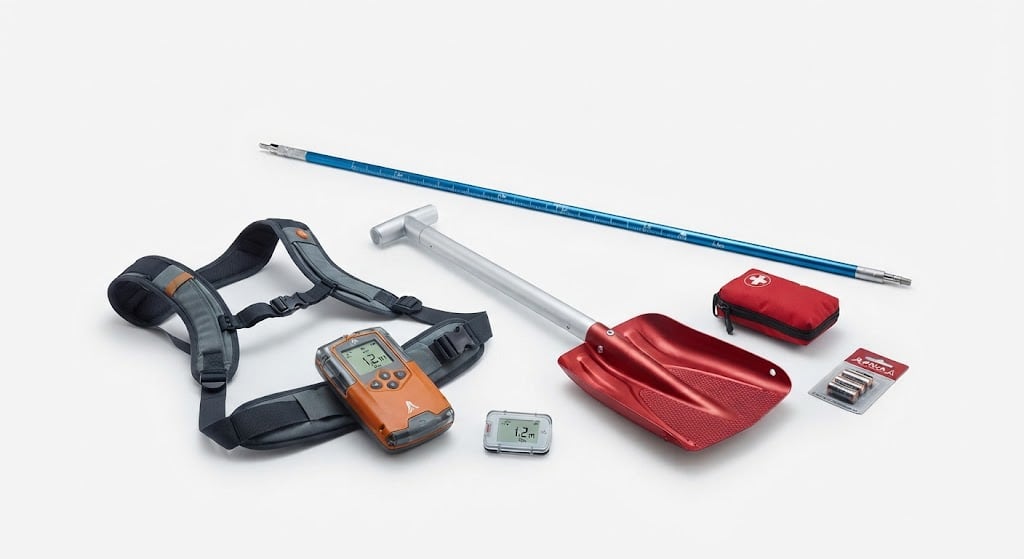
Here the list changes category. These three items go together, always, and there's no point carrying one without the other two:
- A transceiver. It's worn on your body, in its harness and under your jacket, never inside the pack: if the pack is torn away during the slide, it goes with it. Switch it on when you set off and check it's transmitting.
- A shovel, and here we have to be blunt: aluminium, never plastic. Avalanche snow compacts as it stops and sets like concrete; plastic shovels bounce off it or break, which is why they disappeared from the mountain market. The UIAA 156 standard requires, among other things, at least 75 cm of deployed length and 500 cm² of blade area.
- A probe, to pinpoint the location before you start digging. 240 cm or longer.
To that add spare batteries for the transceiver — cold shortens their life considerably — and a first aid kit.
And what doesn't fit on a list: knowing how to use it. A transceiver search under pressure can't be improvised, and the time you have to find someone buried is measured in minutes. If you're going to leave the marked area, take an avalanche safety course before buying anything.
Tools and repairs
There's an important distinction here that usually gets missed, and that separates the reasonable from what you shouldn't do.
On a snowboard, yes. A small multitool with a screwdriver is standard and useful kit: binding screws work loose with vibration, and tightening them on the spot is simple and safe.
On skis, you don't touch the bindings. The release value on a ski binding is calibrated by a technician based on your weight, height, boot size and level, and checked on a machine. Loosening or tightening that setting yourself on the mountain is a direct route to a knee injury, whether the binding releases when it shouldn't or fails to release when it should. If something feels wrong, go down to a workshop.
Beyond that, a bit of duct tape wrapped around a pole takes up nothing and solves more than you'd think.
Water and food
- On piste, a bottle in your pack or in the car is enough.
- If you use a hydration reservoir, bear in mind the tube freezes within minutes even though the water inside is still liquid. How to avoid it is in the backpack guide.
- Simple, calorie-dense food: nuts, chocolate, bars. Nothing that needs cutlery or that freezes.
- Skip the big flask unless you're genuinely going to stop: it weighs a lot for how much it gets used.
First aid kit
A compact one with no pretensions. The basics that actually get used:
- Plasters and dressings, mainly for boot rubs.
- Gauze and a bandage.
- Your usual painkiller.
- A foil blanket, which weighs nothing and keeps an injured person warm until help arrives.
- Disposable gloves.
How to pack the bag
- Heavy items against your back and at mid height. That's what stops the pack pulling you backwards.
- Quick-access items in the outside pockets: sunscreen, food, cloth.
- Shovel and probe in their own compartment. If you go off-piste, that's the one thing that has to come out in a single pull.
- Anything that can't get wet in a separate bag. No pack is completely watertight.
- Nothing hanging off the outside. Anything that hangs catches in the lifts.
What not to carry
Just as useful as the list above, and shorter:
- A complete change of clothes. It takes up a huge amount of room and almost never gets used; one extra thin layer yes, a whole outfit no.
- A big flask, a heavy camera and padlocks. They spend the day in the pack without coming out.
- A map and compass for skiing on piste. The resort map is free and posted at every lift. Compass navigation is touring equipment, not piste equipment.
- A transceiver on its own, with no shovel, no probe and no training. It gives a sense of safety that corresponds to nothing.
Before you go: two checklists
A day on piste
- A charged phone in an inside pocket, with the resort's number saved.
- Lift pass, water, something to eat.
- Sunscreen and lip balm to reapply.
- Spare gloves and a goggle cloth.
Off-piste
- All of the above, plus:
- A transceiver on your body, switched on and checked, with spare batteries.
- An aluminium shovel and probe, in the direct-access compartment.
- A first aid kit with a foil blanket.
- And before any of it: training, and companions who have it too.
A well-prepared pack isn't the fullest one: it's the one carrying exactly what matches what you're going to do that day. On piste, surprisingly little. Off-piste, not much gear but a great deal of preparation behind it.