
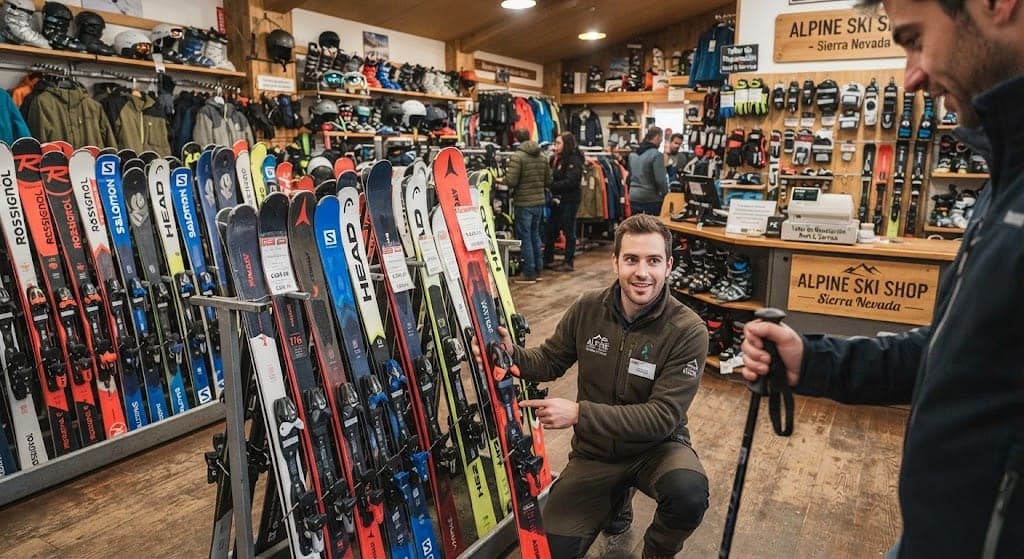
A pair of skis is four numbers: length, waist width, turn radius and flex. If you understand those four, you can read any product sheet and know how the ski will behave before you step on it, without depending on what the salesperson says or on the graphic on the topsheet. This guide is about that, and about a fifth thing that almost never appears in buying guides and without which new skis are no use at all: the bindings.
In short: start from length based on your height and adjust for weight, level and discipline; waist width decides where the ski works — under 85 mm for piste, over 100 for deep snow; and turn radius decides how it turns. If you're starting out: all-mountain or piste, short, soft and narrow. And bindings are mounted and set by a technician, always.
Length: your height is the starting point, not the answer
The chin, nose and head rule is fine as an initial reference, but it stops halfway, and it's easy to see why: two people of 1.75 m weighing 60 and 95 kg don't need the same ski.
Start from your height and adjust from there:
- Shorter — around the chin — if you're starting out, if you're light for your height, if you ride freestyle, or if you ski narrow pistes with tight turns.
- Longer — towards the nose or above — if you go fast, if you're heavy, if you go off-piste, or if you're after stability.
Weight is the adjustment most often forgotten, and the reason is mechanical: a ski works by bending under your load. Someone light on a long, stiff ski can't flex it and ends up fighting it; someone heavy on a short, soft ski overwhelms it and loses grip at speed.
And as always, the size chart for the specific model beats any general rule.
What waist width do I need?
It's the width of the ski at its narrowest point, under the boot, and it's the figure that most determines where it works well.
| Waist width | Where it works |
|---|---|
| Under 85 mm | Groomed piste. Fast edge to edge and very precise on hard snow. |
| 85 - 100 mm | All-mountain. Works on piste and copes in soft snow. |
| Over 100 mm | Deep snow. Plenty of float, but lazy and clumsy on piste. |
The logic is simple: wider means more surface and more float, but more time to move from one edge to the other. A 110 mm ski on an icy piste is awkward and slow to react; a 75 mm one in half a metre of fresh snow sinks.
For skiing in Sierra Nevada, where the vast majority of the area is groomed piste, 80 to 90 mm covers almost everything you'll do.
Discipline
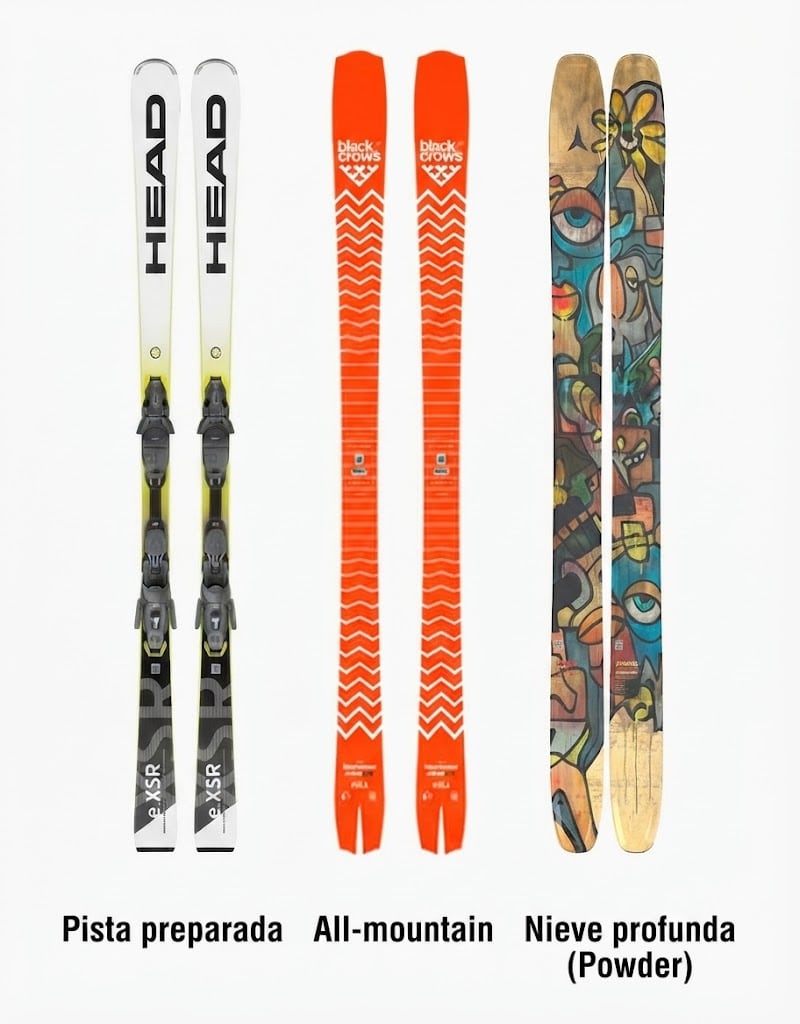
For buying purposes there are really four:
- Piste or race carver. Narrow, with camber and a short or medium radius. Precise and fast on hard snow, awkward off it. For anyone who enjoys drawing lines on groomed piste.
- All-mountain. The compromise, and the default recommendation: an intermediate waist, hybrid profile and reasonable behaviour everywhere. It's what almost everyone needs.
- Freeride. Wide, with rocker at the tip and often the tail too, and directional. For uncompacted snow.
- Freestyle. Twin tip, with both ends raised so you can ski backwards, flexible and very impact resistant.
And separately, touring: light, with bindings that free the heel so you can walk up. It's a different activity, not a different ski.
Racing disciplines — slalom, giant slalom, super-G and downhill — are highly specialised and, above all, very demanding skis. You'll also see them in FIS versions, meaning they meet competition regulations on dimensions and radii; they're even more specific and not designed for recreational use.
Turn radius
This is the figure people ignore and that explains why one ski "turns itself" and another seems reluctant. It's the radius of the curve drawn by the edge: the more pronounced the ski's waist, the smaller the radius and the tighter its natural turn.
| Radius | Turn | Where you see it |
|---|---|---|
| 10 - 15 m | Very tight and agile | Slalom, piste, short skis |
| 16 - 20 m | Balanced | All-mountain, most skis |
| 21 - 30 m | Wide and stable | Giant slalom, speed carving |
| Over 30 m | Very wide | Super-G and downhill |
Choose the radius based on how you ski, not how fast you go: if you like making lots of short turns, a 25 m radius will feel heavy however fast you're travelling.
Profile
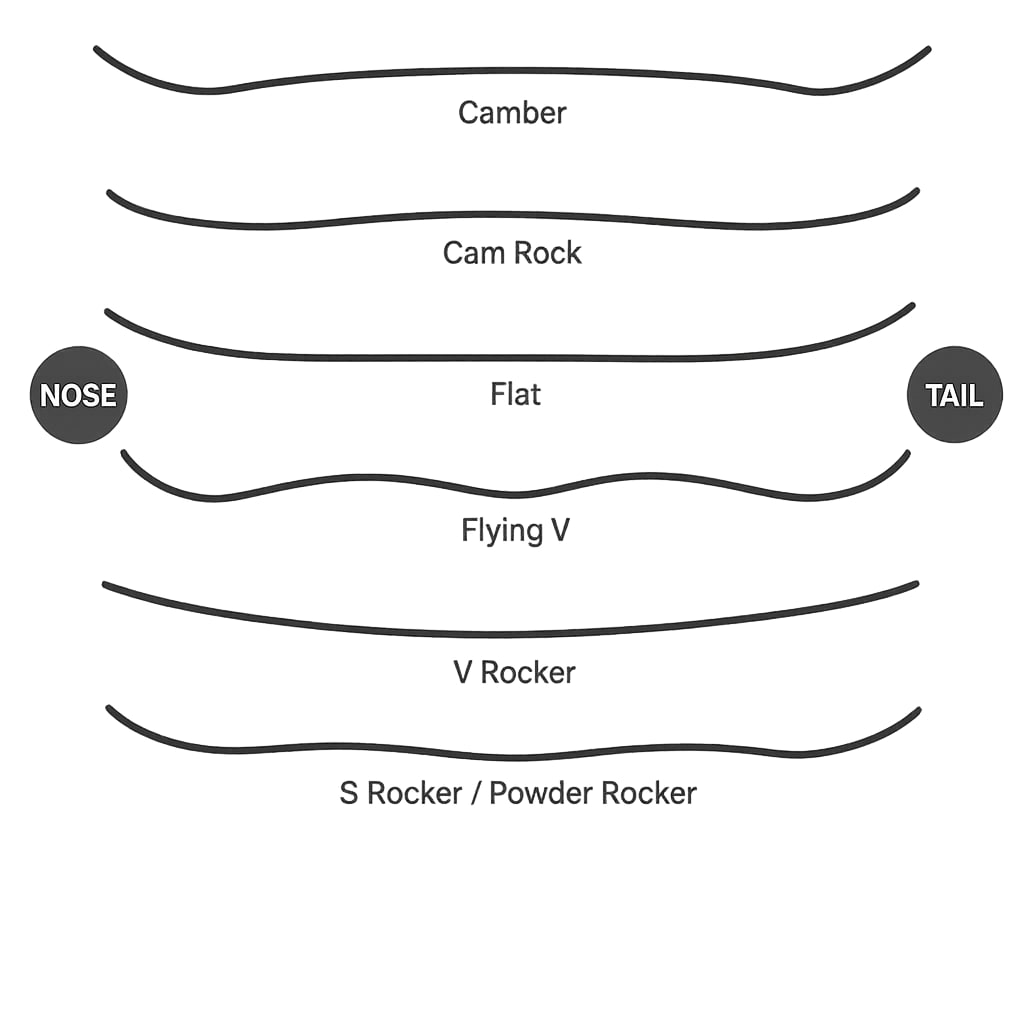
The curvature of the ski seen from the side, resting on the ground. It works much as it does in snowboarding:
- Camber: the classic, with the centre raised. Maximum grip and responsiveness on hard snow, little float and less forgiving.
- Rocker: tip and tail raised. It floats far better and catches less, at the cost of grip and stability on hard snow.
- Flat: level, predictable, a middle ground.
- Hybrid: camber underfoot and rocker at the tip — sometimes the tail too. It's what most all-mountain skis use today, and it works very well.
For piste, camber or hybrid. For fresh snow, rocker or a hybrid with generous rocker.
Flex and torsion
They're two different stiffnesses and it's worth not confusing them.
Flex is resistance to bending lengthwise. Soft forgives and makes turning easier at low speed; stiff holds up at speed and returns more energy, but demands technique and punishes mistakes.
Torsion is resistance to twisting about its axis, and it's what decides whether the edge holds its grip on ice. A ski with good torsional stiffness grips on hard snow even with moderate flex. It almost never appears as a number on the spec sheet, but it's one of the real differences between a cheap ski and a good one in the same category.
And as with snowboards: flex isn't standardised between brands. It works for comparing within a catalogue, not across catalogues.
What they're made of
The distinction here matters, because it's where many guides get it wrong:
- The core is wood in virtually every good ski. The type of wood and how it's laminated determine weight, flex and the ability to absorb vibration. Foam cores appear in entry-level ranges: cheaper and lighter, but less durable and worse at absorbing.
- Fibreglass and carbon are reinforcements, layers wrapping that core. Fibreglass is in all of them; carbon is added to gain stiffness and response for very little weight, and it puts the price up.
- Metal laminates — usually titanal — are the other big variable: they add stability and grip at speed, and also weight. A ski with metal is calmer and more demanding; one without is more playful and easier.
The base, as with snowboards: sintered is faster and tougher but needs proper waxing, and extruded is slower but requires far less maintenance. Sintered is only better if you're going to wax it. We cover it in the tuning tools guide.
Bindings: the part you can't mount yourself
This almost never appears in buying guides, and without it skis are nothing.
Skis are sold two ways: flat, with no binding, so you choose one separately; or with a system binding included, which is standard in entry-level ranges and the simplest option.
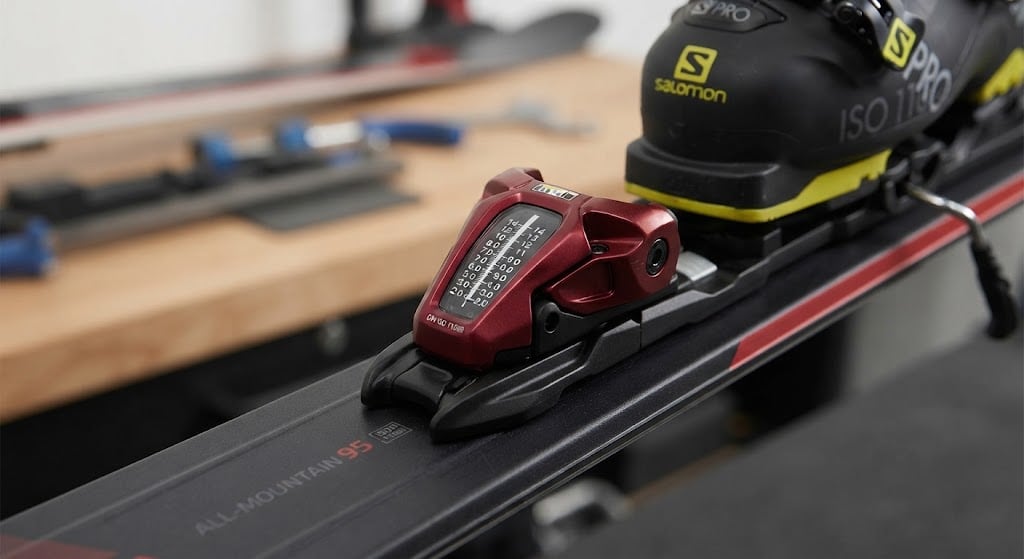
What matters is what comes next. A binding is mounted and set in a workshop, following the ISO 11088 standard, and the setting comes from a combination of data: your weight, your height, your age, your boot's sole length and your skier type — cautious, moderate or aggressive. From that comes the release value, the well-known DIN, which broadly runs between 2 and 7 for beginners and intermediates and between 3 and 12 towards advanced levels.
Three practical consequences:
- Don't touch the setting yourself. Not to tighten it "just in case" and not to loosen it. If the binding releases when it shouldn't, you fall; if it doesn't release when it should, your knee pays the difference.
- If you change boots, go back to the workshop. The sole length changes and the binding has to be reset, even with the same skis.
- Check sole compatibility. It's where most problems arise today, with GripWalk coexisting alongside classic alpine soles. We explain it in the ski boots guide.
And if you buy skis second-hand, budget for the cost of mounting and adjusting the binding to your boot: it isn't optional and it isn't free.
What to buy for your level
| Beginner | Intermediate | Advanced | |
|---|---|---|---|
| Discipline | Piste or all-mountain | All-mountain | Whatever suits your terrain |
| Length | Around chin height | Chin to nose | Matched to use |
| Waist | 75 - 85 mm | 85 - 95 mm | Depends on terrain |
| Flex | Soft | Medium | Medium-stiff |
| Profile | Rocker or flat | Hybrid or camber | Depends on terrain |
| Base | Extruded | Whichever you'll maintain | Sintered |
Demo before you buy
Skis lend themselves to being tried out far better than boots: many shops and the brands themselves run demo days, and premium rental lets you take a specific model out for a whole day.
It's very much worth it, because two skis with the same spec sheet can feel very different. And unlike boots — where buying early is the sensible move — there's no rush with skis: rental ones work perfectly well while you decide.
Before you buy: a quick checklist
- Length from your height, adjusted for weight, level and discipline.
- Waist width based on where you ski: under 85 mm for piste, over 100 only for deep snow.
- A turn radius that matches how you like to turn, not how fast you go.
- Camber or hybrid for piste; rocker or hybrid for fresh snow.
- Don't compare flex between brands.
- Extruded base unless you're genuinely going to wax.
- Budget for mounting and setting the binding, and never touch it yourself.
- Demo first if you can: it's the only way to know how a ski feels.
With length, width, radius and flex clear, you can read a product sheet and know what you're looking at. The rest — the graphic, the brand, this season's technology — matters far less than it seems in the shop.