
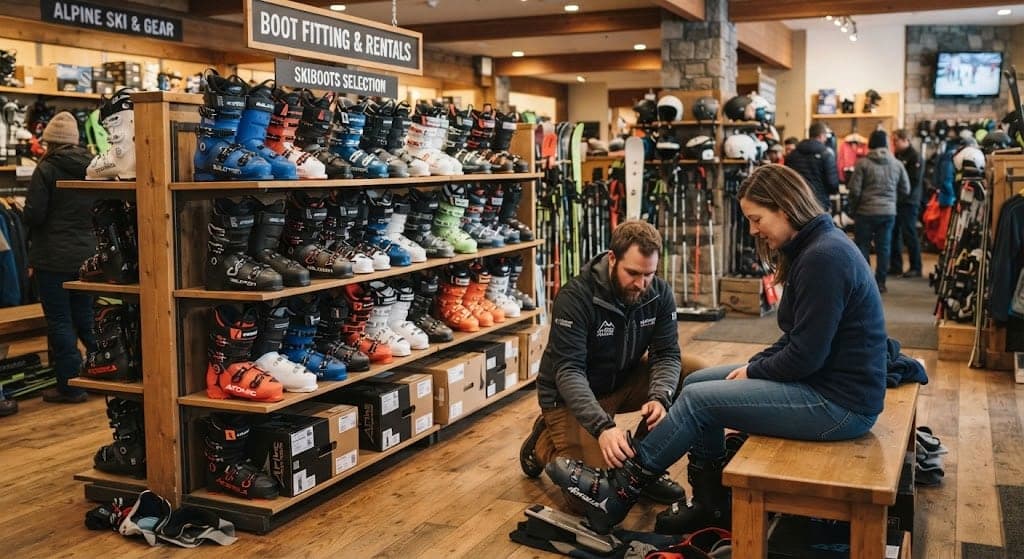
If one piece of kit decides what your day will be like, it's the boot. Mediocre skis are easy to live with; a boot that doesn't fit ruins your day, and a boot that's too big — by far the most common mistake — stops you progressing however much you practise. This guide is about getting it right: how a boot is genuinely measured, why it should feel tight in the shop, what the last is, and why the sole is a safety question rather than a comfort one.
In short: measure your foot in Mondopoint, which is its length in centimetres, and try the boot on flexing, not standing: your toes should brush the front when upright and pull back when you flex, and your heel shouldn't lift. The boot has to feel tight in the shop, because the liner packs out with use. Look at the last — the width in millimetres — as much as the flex. And check the sole is compatible with your bindings, because there's a real safety issue there.
If you're going to buy one thing, buy boots
It's the least intuitive recommendation in this guide and the one people are most grateful for afterwards.
With a snowboard we said the sensible thing when starting out is to rent. With ski boots it's the reverse, and the reason is simple: rental skis work perfectly well, but a rental boot is a boot that has moulded to fifty other people's feet and doesn't mould to yours.
If you ski more than a few days a year, boots are the first purchase, before skis. It's where money converts most directly into comfort and control.
What size ski boots do I need?
Ski boots are sold in Mondopoint, which isn't a conventional size but the length of your foot in centimetres. A 27.5 is a 27.5 cm foot. No conversion tables needed.
How to measure: standing, with your heel against the wall and on a sheet of paper, mark the tip of your longest toe and measure. Do it wearing the sock you'll ski in and at the end of the day, when your foot is slightly swollen. Measure both feet, because almost nobody's are identical, and go with the larger.
That number is your starting point, but not the final answer: two boots in the same Mondopoint can fit very differently depending on the brand and the shape of the last, which we'll come to. Which is why you have to try them on, and try them on properly, which is next.
If you're unsure or you have an awkward foot, a bootfitter can measure you and judge the fit with more expertise than any chart.
They have to feel tight in the shop
This is the most important point in the article and the mistake we see most often.
The liner compresses with use. Over the first few days of skiing it loses a noticeable amount of its volume, and a boot that felt "comfortable from the very first moment" in the shop ends up clearly loose by January. From then on your foot moves inside, your heel lifts as you flex, blisters appear and you lose precision in every turn.
A well-chosen new boot feels snug, wrapped and slightly uncomfortable in the shop, without being painful. Your toes brush the front when you stand upright and pull back slightly when you flex forward into a ski stance. That's the proper check: flex, don't just stand there.
What should never happen: sharp localised pain, numbness, or your heel lifting as you flex.
Buying a size up "to be comfortable" is the surest way never to progress.
The last: the width almost nobody checks
People talk a lot about flex and almost never about the last, and yet the last decides whether a boot will work for you at all.
The last is the width of the boot at the widest part of your foot, measured in millimetres:
- 97-98 mm: narrow. A precise fit, for narrow feet and demanding skiing.
- 99-101 mm: medium. Most people and most boots.
- 102-104 mm: wide. For wide feet, and considerably more comfortable if that's you.
A boot of the right length but the wrong last hurts, and there's no fixing it by tightening or loosening. If you have a wide foot, start by searching by last rather than by brand.
Flex
Flex is the boot's resistance to bending forward, numbered from 50 to 130 or more.
| Flex | Who it's for |
|---|---|
| 50 - 80 | Beginners, recreational skiing, children and teenagers. |
| 85 - 110 | Intermediates and most regular skiers. |
| 120 or more | Advanced, racing, and heavy or very aggressive skiers. |
Three caveats the number doesn't tell you:
- It isn't standardised. A 100 from one brand isn't a 100 from another, exactly as with snowboard flex ratings. It works for comparing within a catalogue.
- Weight matters as much as level. A heavy person bends a soft boot effortlessly and ends up with no support; a light person can't bend a stiff one and ends up skiing upright, leaning back.
- Cold stiffens the plastic. A boot that felt reasonable in the shop can be considerably stiffer at −8 °C.
When in doubt, softer. A boot that's too stiff doesn't make you a better skier: it stops you flexing and throws your weight back.
Soles and bindings: there's safety at stake here
This is the part buyers usually ignore and that can have real consequences, because the wrong combination can stop the binding releasing in a fall.
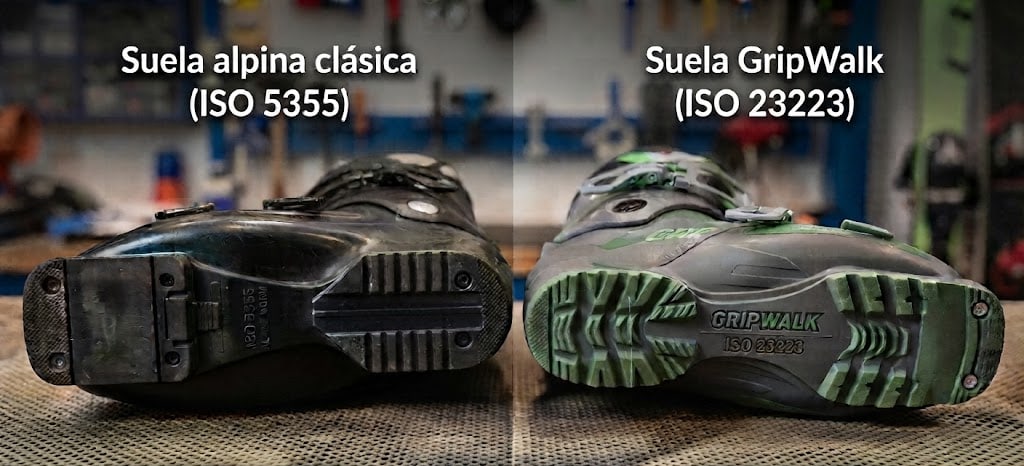
Soles follow specific standards:
| Sole | Standard | Compatible with |
|---|---|---|
| Classic alpine | ISO 5355 | Alpine bindings (ISO 9462) and MNC |
| GripWalk | ISO 23223 | GripWalk, MNC and pin bindings |
| Touring | ISO 9523 | MNC and pin bindings |
GripWalk is now the de facto standard on new boots: a curved, rubberised sole, far more comfortable and safer for walking around a resort. But a GripWalk sole mounted in an older alpine binding not certified for it changes the release behaviour, and that's precisely the mechanism meant to save your knee.
MNC bindings (MultiNorm Certified) accept every sole type, and are the untroubled option if you expect to change boots in future.
Practical rule: when you change boots, take the new boots to the shop where your skis are and have them check and reset the bindings. It isn't optional.
Closure systems
- Metal buckles, usually four. It's the standard, lasts a long time and allows fine adjustment point by point.
- A velcro strap at the top, the power strap. It provides a good part of the cuff's hold, so tighten it properly: many people leave it slack without realising what they're missing.
- The BOA system, a dial that tensions a cable and distributes pressure very evenly. Easy to use with gloves and increasingly common; in exchange it makes the boot more expensive.
- Combinations of buckles with BOA or velcro, aiming for zone-specific adjustment.
None is better than another in the abstract: what matters is still the last and the size.
The liner and heat moulding
The liner is the soft inner part, and in many current boots it's heat mouldable: it's warmed in the shop, you put it on and it takes the shape of your foot as it cools. It's a service that's usually included and very much worth having.
Some shells also allow heat work to widen specific spots. That's bootfitter territory, and it's what turns a boot that "almost fits" into one that fits perfectly.
And one recommendation that applies to almost everyone: a proper footbed. The stock footbed in a ski boot is a shapeless piece of foam, and replacing it with a moulded one improves support, reduces pressure points and often resolves cold feet or numb toes.
Boots for children
- Never a size up "so it lasts". It's the logical temptation and it's a mistake: with room to spare a child can't control the skis, tires sooner and learns worse. Their foot also moves around and they get blisters.
- Low flex always, so they can flex it with their weight.
- Easy to put on, with a wide opening. A boot that takes twenty minutes of struggle every morning exhausts everyone's patience.
- Renting makes a great deal of sense while they're growing: their foot changes every season and buying is throwing money away.
We see it with the families who come to our kids' ski lessons, and it's one of the things that most changes a child's day.
How to put them on and buckle up
Half a dozen details that prevent half the discomfort out there:
- Open the boot properly before putting your foot in, buckles and velcro included.
- A smooth sock, no wrinkles and nothing underneath. No thermal leggings tucked in, no two pairs. We cover it in the socks guide.
- Knock your heel back with a couple of taps on the floor before buckling, so your foot settles where it belongs.
- Buckle from the bottom up, starting with the foot buckles and finishing with the cuff and the strap.
- The instep buckle, not over-tightened. That's where circulation gets cut off most, and a foot with no blood flow is a cold foot.
- Open them at stops. Ten minutes with the buckles undone over lunch completely changes the second half of the day.
Before you buy: a quick checklist
- Measure your foot in Mondopoint, at the end of the day and in your ski sock.
- Try them on flexing: toes pull back and the heel doesn't lift.
- They have to feel tight in the shop: the liner packs out with use.
- Check the last in millimetres, especially if you have a wide foot.
- Flex matched to your level and your weight, and softer when in doubt.
- Verify sole-binding compatibility, and take new boots in to be adjusted.
- Make use of heat moulding and consider a moulded footbed.
- Flex inside the boot before deciding. Don't judge it standing still.
The right boot isn't the most comfortable one in the shop: it's the one that holds your foot without pain and lets you flex. Get the size, the last and the compatibility right, and the rest of your kit matters far less than you'd think.