
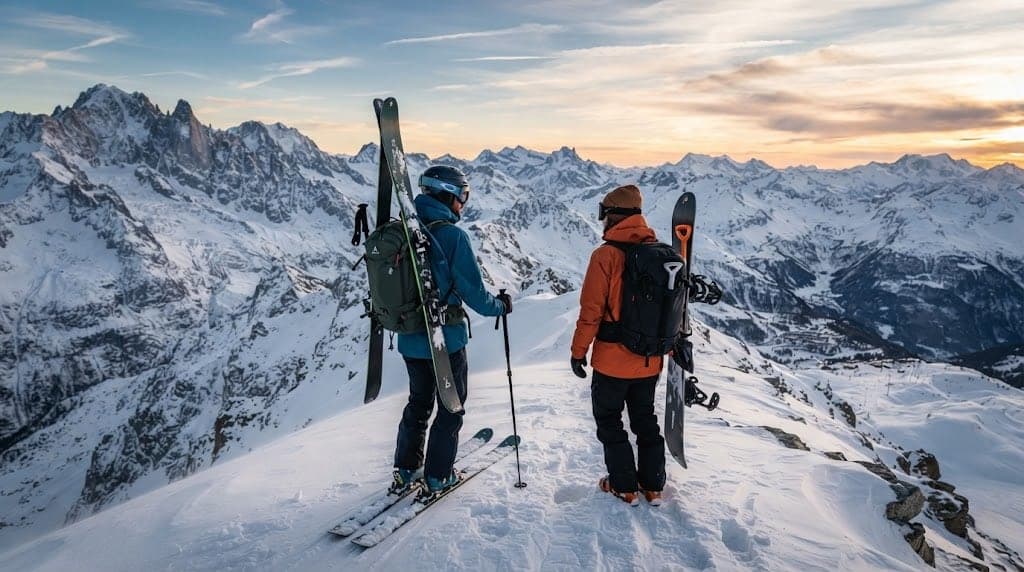
Before looking at models it's worth answering a question almost no guide asks: do you need a backpack? For a normal day on piste, probably not, or a very small one. And at the other extreme, if you're going off-piste, the pack is the least of it: what you need is training and safety equipment, and the pack is just how you carry it. This guide is about getting both cases right, and about what the data says on airbag packs, which isn't quite what's usually claimed.
In short: for skiing on piste, 10 to 20 litres is plenty, and many days not even that. For going off-piste, 20 to 35 litres with a separate rescue compartment. And on airbags: studies suggest they roughly halve mortality among those caught, but one in five doesn't inflate, almost always through user error. It replaces neither training nor a transceiver, shovel and probe.
Do you need a backpack?
It's worth pausing here, because a lot of people buy a pack by default and then leave it in the car.
If you ski on piste, the honest answer is that most days you don't. The lifts return you to the base regularly, there are restaurants at the resort, and everything you genuinely need fits in your jacket pockets. A pack adds weight, heat and one specific nuisance on the chairlift that we cover below.
It does make sense in three cases:
- When you have children and need to carry their things: spares, extra gloves, food.
- When you spend the day out and don't want to come down for lunch.
- When the extra gear is heavy: a camera, a big bottle, spare layers.
If you go off-piste, then yes, always, and not for convenience: it's where the safety equipment goes.
And if you snowboard on piste, bear in mind you'll be sitting in the snow many times a day, and a loaded pack complicates every time you get up.
The pack on the chairlift
This is the practical drawback nobody mentions and that decides whether you end up using it or not.
On a chairlift with a backrest, a pack worn on your back pushes you forwards and leaves you perched on the edge of the seat, which is uncomfortable and less safe. The correct approach is to take it off and hold it on your lap, or hang it from one knee. That means doing it on every ride up, and if that's fifteen rides a day, you notice.
It's another reason to carry the smallest pack that solves your day, rather than the biggest one you own.
If you also wear a back protector, check the pack doesn't sit awkwardly on top of it: some are designed to work alongside protection, and some have it built in. Which ones you need is in the protection guide.
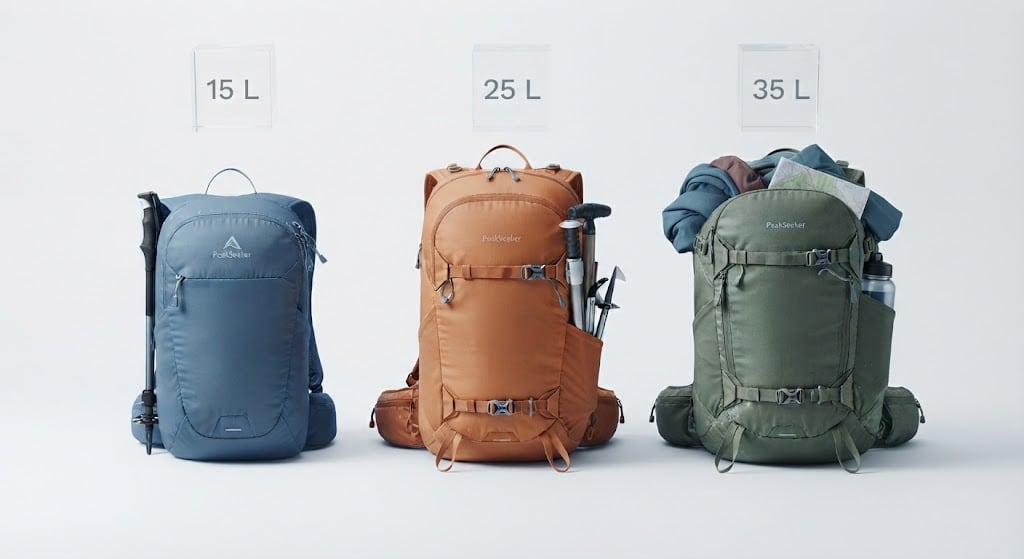
Capacity: how many litres
| Litres | What for |
|---|---|
| 10 - 20 L | A day on piste. Water, food, an extra layer and not much else. |
| 20 - 35 L | A day off-piste, with safety equipment and spare clothing. |
| Over 35 L | Long tours or overnights. |
The usual mistake is buying too big "just in case". A large half-empty pack sways on your back, and it also invites you to fill it. For 90% of people skiing on piste, 20 litres is a ceiling, not a starting point.
Fit and ergonomics
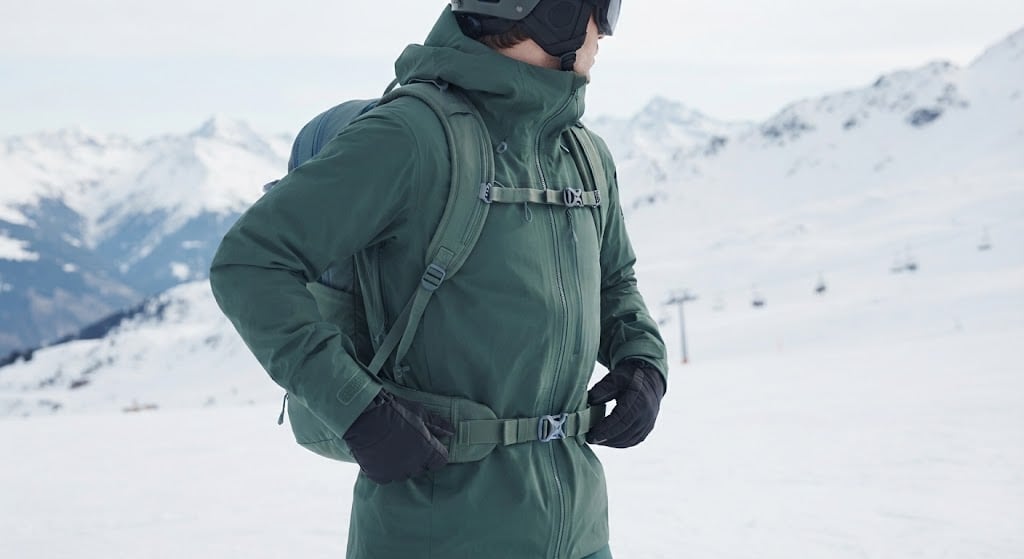
A pack that moves on every turn tires you and unbalances you, so this matters more than it does hiking.
- A hip belt, which is what actually fixes the pack to your body and takes the load off your shoulders. Essential from 20 litres up.
- A sternum strap, which stops the shoulder straps splaying.
- A narrow, low profile, so it doesn't hit your helmet when you look up or the chairlift backrest.
- Buckles and zips you can work with gloves on. Try it that way, not bare-handed: a zip with a tiny pull is useless on a mountain.
- Back length, if the brand offers sizes. It's what makes the weight sit on your hips rather than your shoulders.
Carrying your skis or board
It's for walking, and there are three systems:
- Diagonal, one ski or the board across your back. Quick to set up and remove, and the most common on short outings.
- A-frame, both skis at the sides, one on each flank. More stable and better balanced for long climbs, though slower to set up and take down.
- Vertical, typical for a snowboard, holding it flat against your back.
What matters is that the straps genuinely cinch down and that the system can be used with gloves. A badly secured ski that shifts with every step ends up on the ground.
The hydration system and the cold
There's a very specific problem here that product sheets don't mention: the tube freezes.
The reservoir sits inside the pack, protected by your own body heat, but the tube is outside and exposed. Below freezing, the water left in the tube after you drink freezes within minutes and cuts you off from the reservoir, even though the water inside is still liquid.
What works:
- An insulated tube sleeve and a bite valve with a cap, which is the minimum for it to make sense on snow.
- Blow back into the reservoir after every sip, to empty the tube. That's the trick that genuinely solves it.
- Or skip the system and carry a bottle inside the pack, upside down, which is what many people do in winter: ice forms at the top first, so upside down it takes longer before you can't drink.
For a day on piste, an ordinary bottle is more than enough.
Do airbag packs work?
This is where it's worth being precise, because it's safety equipment and the gap between "very safe" and what the studies actually show matters.
An airbag pack carries one or two balloons that inflate when you pull a handle. The idea is that greater volume tends to keep you nearer the surface as the snow moves, reducing the likelihood of being buried.
What the data shows. The reference study analysed real accidents in Europe and North America between 1994 and 2012:
- Among those caught, an inflated airbag reduced mortality from 22% to 11%: an absolute reduction of 11 points.
- The risk of critical burial dropped from 47% to 20% with the airbag inflated.
- But one in five airbags failed to inflate, and around 60% of those failures were down to the user: not pulling the handle, not having it accessible, or not having the system armed.
Translated: it's a real, measurable benefit, not a marketing trick. But 11 out of every 100 people caught with an inflated airbag still died, and the system does nothing against trauma from hitting trees or rocks, nor against being buried where the snow piles up.
What it isn't. An airbag doesn't replace a transceiver, shovel and probe, nor the training to use them, nor the judgement to decide where and when you drop in. It's the last line, not the first. And there's a documented effect worth keeping in mind: safety equipment tends to make people take on more risk than they otherwise would, so part of the benefit is lost along the way.
If you're thinking about going off-piste, the correct order is training first, rescue equipment second and airbag last, not the other way round.
The rescue compartment
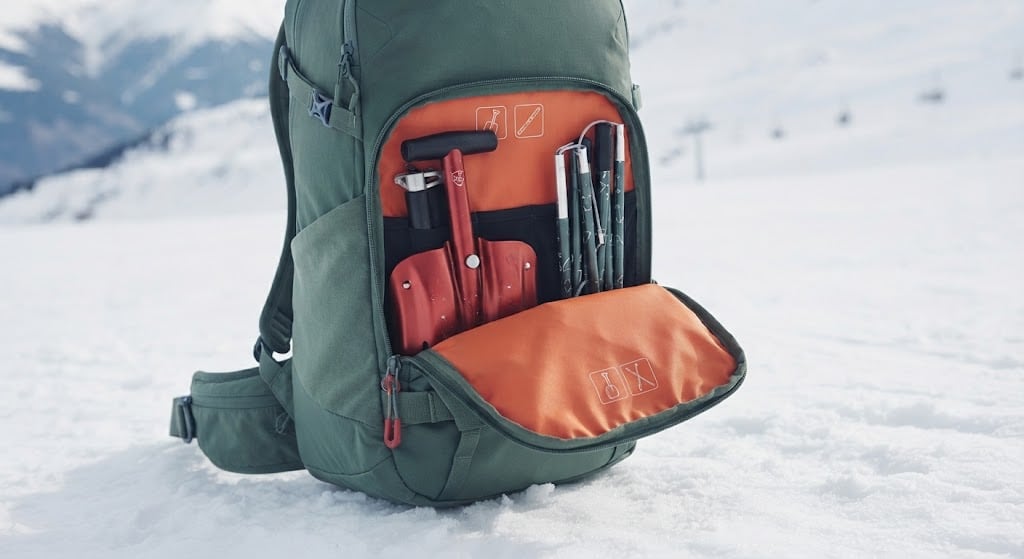
Packs designed for off-piste have a separate compartment with direct access for the shovel and probe, and it isn't an organisational nicety: in a rescue, seconds count, and you can't be emptying the pack into the snow to find the shovel under your sandwich.
It should be its own compartment, open in one pull, and be workable with gloves on. The transceiver doesn't go in the pack: it's worn on your body, under your jacket, because if the pack is torn away in the avalanche it goes with it.
Materials and care
- High-tenacity nylon for the body: abrasion resistant and light. It's the norm and what you want.
- Waterproof coatings on the inner face. No pack is genuinely watertight through the seams and zips, so anything inside that can't get wet goes in a separate bag.
- Robust zips with big pulls, which is the first thing to fail and what gets used most with gloves.
- Always dry it out inside at the end of a trip, especially if you've carried a water reservoir or wet clothing.
- If it has an airbag, follow the manufacturer's service intervals, check the cartridge charge before every outing and practise the pull. A system you can't operate under stress is dead weight: remember that most failures are down to the user, not the device.
Before you buy: a quick checklist
- Ask yourself first whether you need one: for piste, many days you don't.
- 10-20 L for piste, 20-35 L for a day off-piste.
- A hip belt and sternum strap from 20 litres up.
- Try the zips and buckles with your gloves on.
- A low profile that clears your helmet.
- A separate rescue compartment if you go off-piste.
- The transceiver is worn on your body, never inside the pack.
- Airbag: fine, but after the training and the rescue equipment, not before.
The right pack is almost always smaller than you think. And if the reason you're looking at packs is to go off-piste, the important purchase isn't the pack: it's the course.