
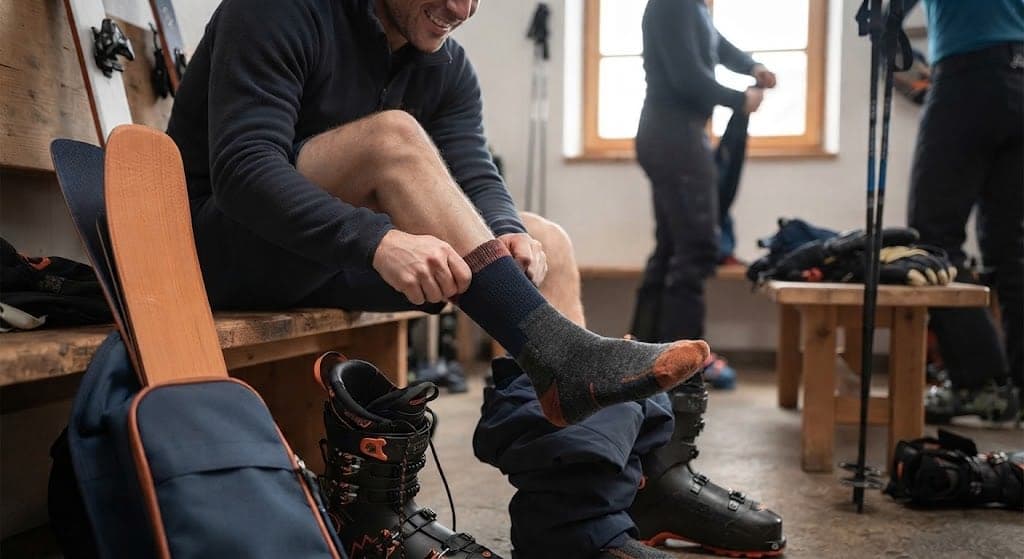
It's the cheapest thing you'll put on and the only one compressed inside a rigid shell for eight hours. That combination explains why a bad sock is so noticeable, and why it's behind most of the cold feet, blisters and shin rubs we see in lessons. It also explains the rule that's hardest to believe: to have warm feet, you almost always need less sock, not more.
In short: one pair, made for skiing, thin through the part inside the boot and padded only on the shin and instep. Tall, above the cuff. No cotton. And if you're cold, don't go thicker: go thinner and check your boot fit.
Why a normal sock won't do
Inside a ski or snowboard boot there's no room. The boot is fitted to the volume of your foot plus the sock, and from there on everything surplus gets in the way.
A normal sports sock fails on three counts at once: it's a uniform thickness, so there's surplus material where it isn't needed; it usually contains cotton, which holds moisture against your skin; and it doesn't come above the cuff, so the rigid edge of the boot rubs directly on your leg.
The result is pressure points, damp, and a shin rub that shows up mid-morning.
Thick socks or thin socks?
This is the counterintuitive part, and where most people get it wrong.
| Thickness | When |
|---|---|
| Ultra-thin | Very tight boots, spring, anyone after maximum feel. |
| Medium | The default for almost everyone. |
| Thick | Severe cold and a boot with room to spare. |
The reason thick comes last and with conditions attached: the boot has a fixed volume. Adding more sock compresses your foot, blood circulates worse, and the air pocket that actually insulates disappears. A tight foot is a cold foot, always.
So if your feet are cold, the answer is not a thicker sock, which is what everyone does. It's the reverse: try a thinner one, and above all check your boot fit. Most cold feet are a boot problem, not a sock problem.
And for the same reason, never two pairs. We cover it in the base layer guide too, because it's the mistake we repeat most in lessons.
The materials
- Merino wool. It regulates temperature very well, keeps insulating somewhat even when damp, and barely holds odour, which you appreciate on a multi-day trip. It's the best for cold, and the most expensive.
- Polyester and polyamide (nylon). They dry faster and stand up to wear far better. Polyamide is what stops a sock wearing through at the heel after three outings.
- Elastane, always in a small proportion. It's what keeps the sock in place and stops it wrinkling, which is why it matters more than its percentage suggests.
- Merino and synthetic blends. The norm in good snow socks, and what we'd recommend: merino brings regulation and odour control, synthetic brings durability and fit.
- Cotton, never. It absorbs sweat, holds it against your skin and doesn't dry. Inside a closed boot it's the worst possible decision.
A 100% merino sock sounds good but wears through quickly; what you want is merino with a decent percentage of synthetic.
The padded areas
A technical sock isn't the same thickness all over the foot, and much of its value lies there.
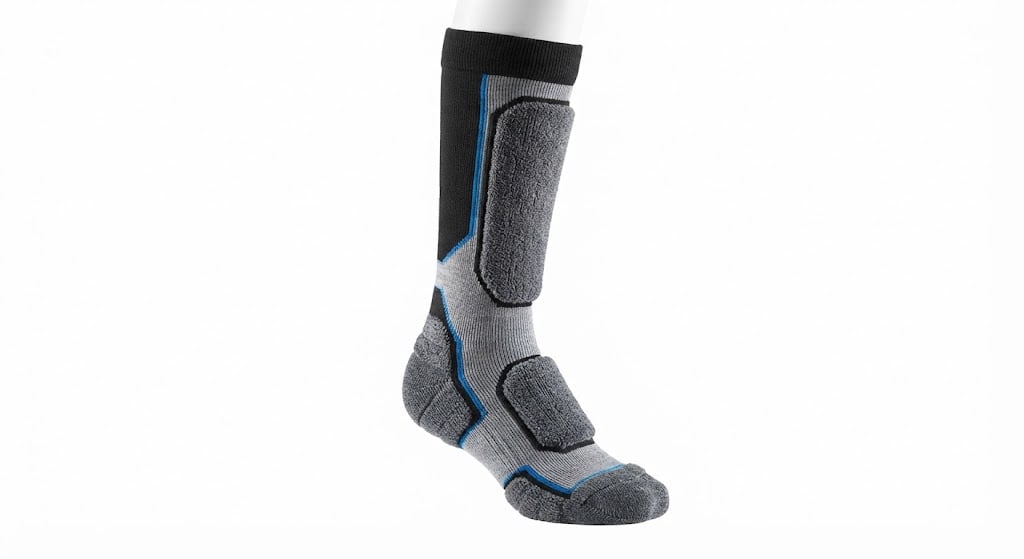
- Shin: the most important area in skiing. The boot cuff presses exactly there as you flex, and padding along that strip prevents the classic rub.
- Instep: where the boot buckle clamps down.
- Heel and sole: reinforcement for wear, not cushioning. In a rigid boot you don't need cushioning: you need it not to wear a hole.
- Everything else as thin as possible, so the boot still transmits what your board or skis are doing.
Height
Always above the boot cuff, no exceptions. A sock that sits below it lets the rigid edge rub directly on your skin, and over a day's skiing that ends in a serious rub.
In skiing the cuff is higher than in snowboarding, so if you're buying one pair only, take the ski height: you'll have a couple of fingers spare in snowboarding and it makes no difference.
Putting them on properly
It sounds obvious and it's responsible for half the discomfort out there.
- No wrinkles. Pull it smooth before your foot goes in the boot: a fold inside a rigid boot becomes a pressure point within twenty minutes.
- Toe seam positioned. If the sock has a seam, keep it flat over your toes, not underneath.
- Nothing underneath. This is the mistake almost nobody identifies: don't tuck your thermal leggings or trousers inside the sock. It creates a fold and an extra layer exactly where the boot clamps down. The base layer ends above the cuff or goes outside the sock, never inside the boot.
- Pull the sock up after putting your trousers on, not before, or it will have slipped down without you noticing.
- Always dry. A damp sock insulates far worse. If you finish the day with wet feet, a clean pair the next day.
Skiing or snowboarding: are they different?
Yes, though the difference is smaller than the marketing suggests.
Ski socks are taller and have more shin padding, because the boot is stiffer and the cuff higher. Snowboard ones tend to be slightly more flexible with the padding distributed differently, because the boot is soft and you flex your ankle in another way.
If you do both, ski socks work fine for snowboarding. The other way round works worse, mainly on height.
Compression
Compression snow socks exist, with a considerably stronger fit. They work as socks and many people find them comfortable, but it's worth lowering expectations: their claimed circulation, performance and recovery benefits have been debated for years without a clear conclusion.
If you find them comfortable, go ahead. You don't need to pay for compression to get a good ski sock.
Care
- Cold or warm water and a gentle cycle.
- No fabric softener, which coats the fibre and cancels its ability to move moisture.
- No tumble dryer, especially with merino, which mats and shrinks.
- Inside out, so the face that sits against your skin gets properly cleaned.
- Retire them when the padding flattens. A worn technical sock has lost exactly what made it technical, even without holes.
How many to take
One clean, dry pair per day. Four days means four pairs: they're cheap and the weight in your case is negligible compared with the problem of putting on a damp sock at eight in the morning.
If you're tight on luggage, merino handles a second wear better than synthetic, but it isn't ideal.
Before you buy: a quick checklist
- Made for skiing or snowboarding, not sports socks.
- A blend of merino wool and synthetic.
- Thin through the boot area, padded only on the shin and instep.
- Above the boot cuff, always.
- No thick seam at the toe.
- One pair per day, and never two at once.
- And if your feet are cold: thinner, not thicker, and check the boot.
It's the cheapest purchase in your whole kit and one of the most noticeable. The right socks fix more cold feet than any heated insole, and cost a fraction of the price.