
It's the cheapest piece of kit you'll own and the one people think about least: most of us take whatever the rental shop hands over and never consider it again. And yet there are two things about poles worth five minutes, because one affects how you ski and the other affects the most common hand injury in the sport. This guide is about getting the length right, understanding the other parts, and how to hold a pole so you don't end up at the doctor's.
In short: the length comes from multiplying your height in centimetres by 0.7 and rounding to the nearest multiple of 5 — for 1.75 m, about 120 cm. Aluminium unless you race. And if you're just starting, consider skiing without them for the first few days: they get in the way more than they help while you're learning to balance.
Do you need poles?
It seems an odd question in a guide about poles, but it's the first one to ask, and the answer isn't always yes.
In snowboarding, no. They aren't used, they aren't needed, and there's no debate.
In skiing, and if you're starting out, probably not for the first few days either. It's what we do in lessons with anyone who has never skied: the first runs go without poles. The reason is that early on, balance is learned through your body and your feet, and anyone holding poles tends to lean on them, plant them to slow down, and put their hands where they shouldn't be. Without poles, your hands stay in front and your body learns sooner. They come in once you have the snowplough and start linking turns.
From then on, yes. The pole sets the rhythm of the turn, helps with coordination and lets you push yourself along a flat or in a queue. Anyone skiing with any fluency misses them badly if you take them away.
If you're starting out with us, don't worry about buying them: we cover it in the ski lessons in Sierra Nevada and tell you when it's time.
What length poles do I need?
It's the one figure you can get wrong in a way that affects how you ski, and it takes a second to work out.
Multiply your height in centimetres by 0.7 and round to the nearest multiple of 5, which is how they're sold.
| Your height | Approximate pole |
|---|---|
| 1.60 m | 110 cm |
| 1.70 m | 120 cm |
| 1.75 m | 120 - 125 cm |
| 1.80 m | 125 cm |
| 1.90 m | 135 cm |
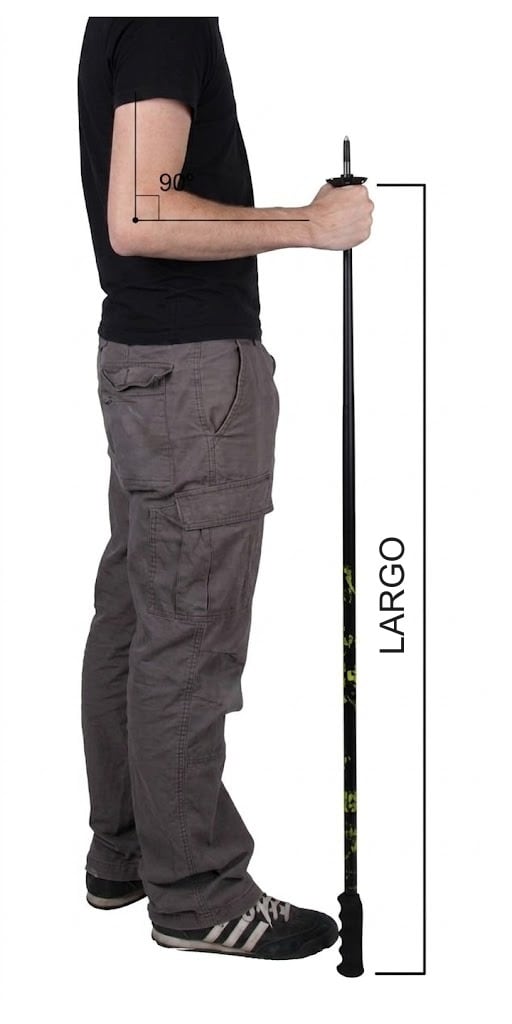
And the in-shop check, which is more reliable than any formula: hold the pole upside down, with the grip resting on the ground, and take hold just below the basket. If your elbow is at a right angle and your forearm is horizontal, that's your size. If your elbow opens out a lot, the pole is short; if it closes up, it's long.
What happens if you get it wrong: too long forces you to lift your shoulder and lean back at the moment you plant, which is exactly the opposite of what you want. Too short makes you stoop to reach the ground and you lose push on the flats.
One nuance: the formula is for alpine skiing on piste. For touring people tend to go slightly longer for the climb, and for freestyle considerably shorter.
Material: aluminium or carbon
There are only two answers, and for most people it's the first.
- Aluminium. Tough, cheap and forgiving: it dents before it breaks, and a dented pole still works. It's what we'd recommend to almost everyone.
- Carbon. Lighter and stiffer, which you appreciate touring or racing, where weight counts across thousands of movements. In exchange it's expensive and fails differently: it doesn't bend, it snaps, and usually without warning after a knock that didn't look serious.
- Mixed, with carbon at the top and aluminium at the bottom, aiming for lightness without the fragility in the area that takes most of the knocks.
For skiing on piste, a thirty-euro aluminium pole does exactly the same job as a hundred-and-fifty-euro carbon one.
Grip, strap and skier's thumb
This is the important section, and the one no product sheet will tell you about.
Skier's thumb is an injury to the thumb ligament, and it isn't a rarity: it accounts for over 60% of hand injuries in skiing and is the most frequent upper-limb injury in the sport. The mechanism is nearly always the same: you fall, you put your hand down in the snow with the pole still gripped, the pole acts as a lever between the ground and your thumb, and your thumb is forced open further than it should go.
On straps there's a widespread idea — "take them off and you won't get hurt" — worth qualifying, because the available evidence doesn't say quite that: skiing without straps doesn't on its own reduce the risk, but letting go of the pole during the fall does appear to protect you. The difference matters, because the practical conclusion isn't "straps off" but "learn to let go".
What to do with that:
- Let go of the pole the moment you feel yourself falling. Don't try to save it: it's the cheapest thing you own.
- Adjust the strap, don't leave it hanging. A loose strap catches your thumb in a fall.
- Off-piste or among trees, better without a strap, so the pole can go if it snags.
- Release systems like Leki's Trigger, where the glove clips to the pole and releases when pulled hard. They need compatible glove and pole from the same system; we explain it in the gloves guide.
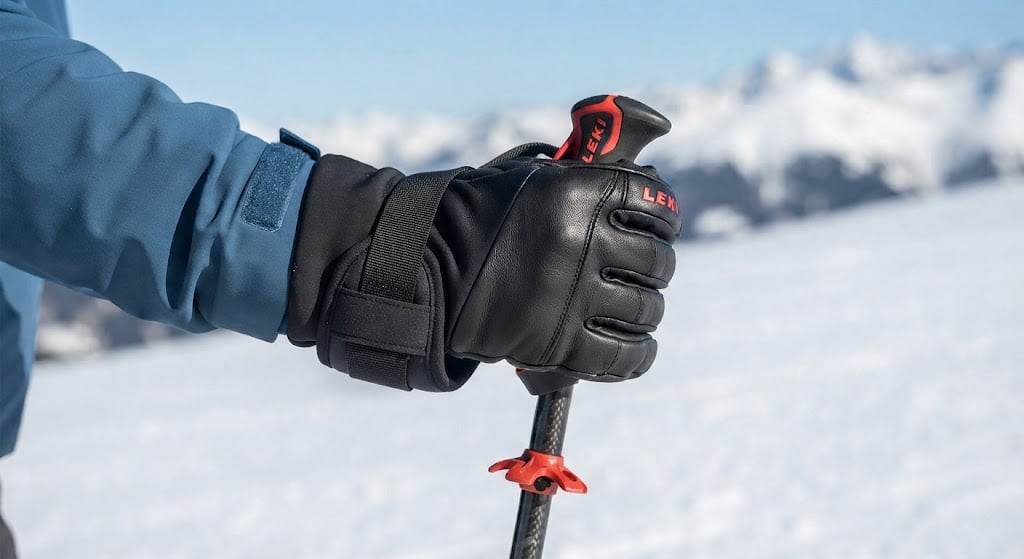
On the grip, not much else: it should be comfortable with your glove on — try it that way, not bare-handed — and it shouldn't slip.
Tip and basket
The two parts at the bottom, both replaceable and both wear items.
- The tip is hardened steel and is there to bite into hard snow and ice. It wears with use, especially if you walk a lot on tarmac or stairs with your poles; over time it rounds off and stops gripping.
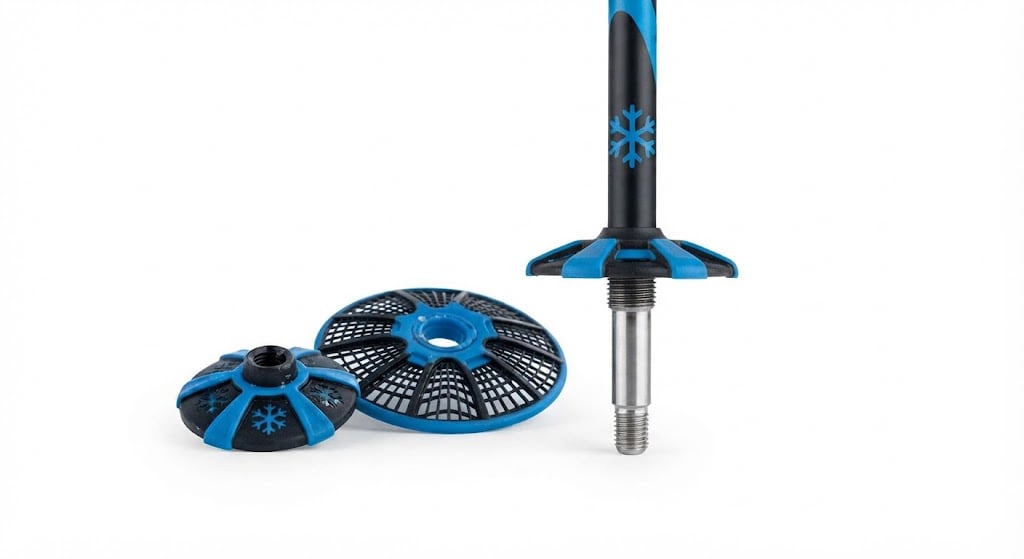
- The basket is the disc above the tip, and its job is to stop the pole sinking. Small for piste, which is what nearly every alpine pole comes with; large for deep snow, because in powder a small basket sinks up to the grip and won't support you.
Baskets are interchangeable and cost very little. If you're going off-piste on a fresh snow day, switching to large baskets is the cheapest upgrade there is.
Fixed or adjustable
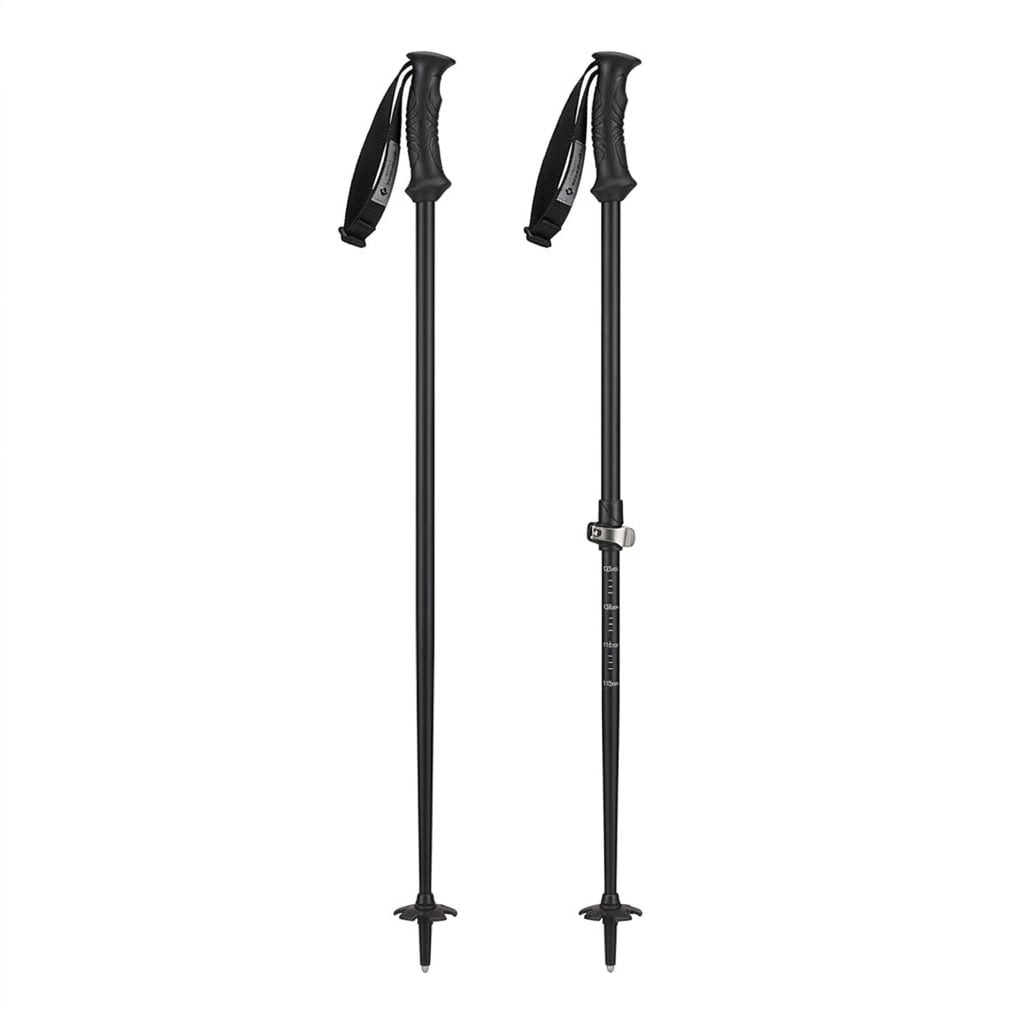
- Fixed: one piece. Lighter, stiffer, and nothing that can fail. It's the norm on piste and what 90% of people need.
- Adjustable, in two or three sections with a quick lock. Their point is touring, where you shorten them to climb and lengthen them to descend, and being able to lend them or fit them in a suitcase. In exchange they weigh slightly more and the lock is a part that can slip if it isn't tightened properly.
If you ski on piste, fixed. If you walk up, adjustable.
Poles for children
- The same formula, height times 0.7, but measured every season because they grow.
- Aluminium always. Carbon makes no sense at all here.
- No strap, or a very loose one while they're small: it matters more that the pole leaves their hand in a fall than that they don't lose it.
- And don't rush to give them poles. As with adults, the first days are better learned without them. We cover it in the kids' ski lessons.
Care and when to replace them
- Dry them at the end of the day, especially if they're adjustable: water inside the shaft freezes and jams the lock.
- Check the shaft for dents or cracks. In aluminium a pronounced dent is the warning that it will bend there; in carbon, any crack or splinter means replacing it, because it snaps without warning.
- Replace baskets when they crack, which is common, and the tip once it's rounded off.
- Don't use them as a lever to knock snow off your bindings with sideways force: it's the most common way to bend one.
A well-treated aluminium pole lasts for many years. Usually it gets lost before it breaks.
Before you buy: a quick checklist
- Length: height in cm × 0.7, rounded to the nearest multiple of 5.
- Check it upside down, gripping below the basket: elbow at a right angle.
- Aluminium, unless you tour or race.
- Fixed for piste; adjustable only if you walk up.
- Try the grip with your glove on, not bare-handed.
- Large baskets if you're heading into deep snow; they're cheap and swap in a minute.
- If you're starting out, don't rush: the first days are better learned without them.
It's the least important purchase in your whole kit, which is exactly why it isn't worth complicating: get the length right, buy aluminium, and learn to let go when you fall. That's the lot.