
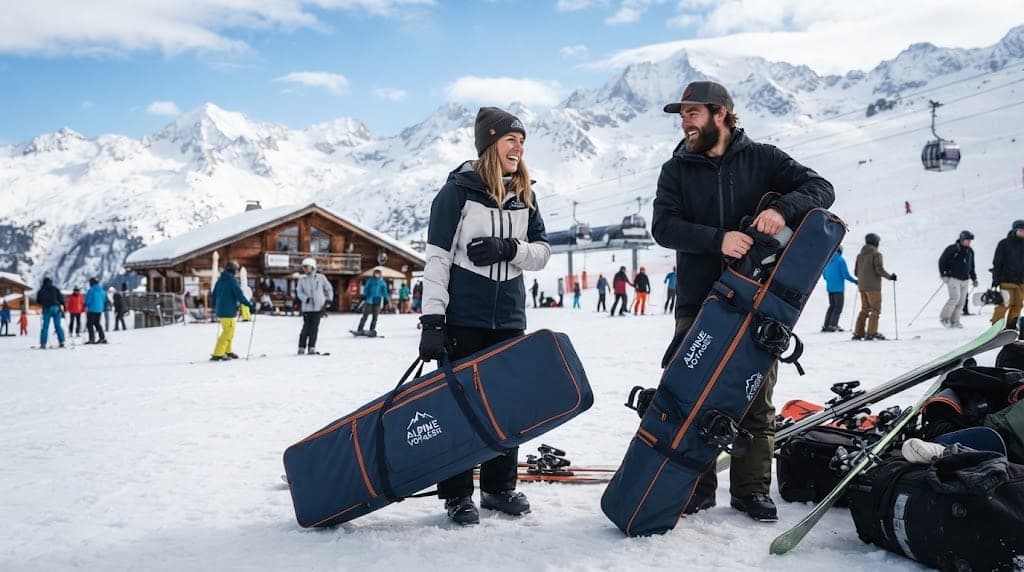

A travel bag looks like the least interesting accessory you'll own, and yet the most expensive damage a board or a pair of skis suffers almost never happens while skiing: it happens in an aircraft hold, in a car boot, or in a storage cupboard over the summer. This guide is about choosing a bag, yes, but above all about the three situations where gear genuinely gets ruined — and about a very common mistake that rusts edges within days.
In short: if you don't travel with your gear, you probably don't need a bag. If you travel by car, a simple padded one is plenty. If you fly, properly padded and with room to pack clothing around it, which is the best filling there is. And most important, whatever the bag costs: never store your gear wet inside it, because the edges rust within days.
Do you need a bag?
As always, it's worth starting there.
If you rent your gear, no. You have nothing to transport or store.
If you own gear but ski close to home, probably not either: to carry it in the car a few times a year, a cheap bag or even an old blanket does the job.
You do need one in three specific cases: if you fly, if you carry your gear on a roof rack or box, or if you store it for months out of season.
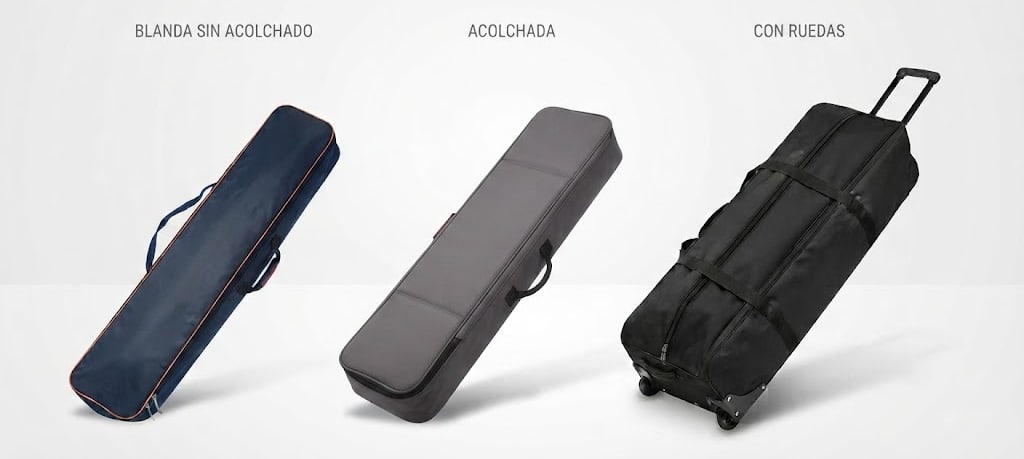
Types of bag
| Type | Protection | What for |
|---|---|---|
| Unpadded soft bag | Low | Storage at home, short car journeys. |
| Padded | Medium | The most versatile. Car, roof rack, flying with care. |
| Semi-rigid or hard | High | Frequent air travel or expensive gear. |
| Wheeled | Medium-high | Airports and long walks. |
| Double or multiple | Medium | Couples and families, or carrying skis and a board together. |
Two notes on that table:
Wheeled bags solve a very real problem — hauling twenty kilos through a terminal — but the wheels and frame add weight, and that weight counts at the check-in scale. If you're tight on kilos, think about it.
Double bags are efficient on space and usually work out well, but be careful: a full double bag weighs twice as much, and many airlines charge per item by weight. Two single bags sometimes work out cheaper than one overweight double.
Sizing
Measure your gear tip to tail and add 10 to 15 cm. You need that margin so the tips aren't pressed against the seam, which is exactly where bags split.
What almost nobody says is that going too big is also bad: in an oversized bag the gear moves around, and on a long journey that constant movement wears the bag from the inside and leaves marks on your kit. If you have a lot of space left over, fill it with clothing.
If you're going to put boots inside, you also need volume, not just length: look for bags that say so explicitly, because a pair of boots takes up far more room than you'd think.
Flying
This is where most gear gets broken, and where a few habits make the difference.
- Declare the gear in advance. Airlines usually treat it as special or sports baggage, with its own fee, and it's nearly always cheaper booked with the ticket than presented at the desk. Check your specific airline's conditions, because they vary a fair amount: maximum sizes, weight included, and whether poles or boots count separately or within the same item.
- Pad it with clothing. It's the best padding you'll get, it's free and it frees up space in your suitcase. Protect the tips and tails above all, which is where the knocks land.
- Protect the edges from each other if you're carrying two pairs: base to base, or with fabric in between. An edge against another ski's base makes a clean cut.
- Loosen your snowboard bindings or remove them if it's easy: it reduces bulk and stops the screws levering in a knock.
- Boots in the cabin with you if you can. It's the advice that prevents the most grief: if your luggage is lost or delayed, skis can be rented at any resort, but boots are the piece fitted to your foot, and finding borrowed ones that work is another matter.
- Label the bag inside and out, with your name and phone number. External tags get torn off constantly.
- Photograph the gear before checking it in. If it turns up damaged, that's what you'll need to make a claim.
Travelling by car
Less dramatic, but it has its own classic mistake.
- Inside the car rather than on the roof, if it fits. On a rack the gear is exposed to road salt, grit and dirty rain for hours.
- If it goes on a rack or in a box, always in a bag, and properly secured. Mountain road salt is particularly aggressive with edges.
- Don't leave it in the car in the sun. A closed boot reaches very high temperatures, and prolonged heat does no favours to bases or adhesives.
- And don't leave it in the car overnight wet, which leads straight into the next section.
Why do ski edges rust?
This is the important part of the article, and it's the opposite of what's usually said.
It's often repeated that a bag should be waterproof "to protect your gear from moisture". And yes, a waterproof bag keeps water out. But it also keeps it in. If you put a wet board or skis in and zip it up, what you've made is a sealed damp chamber around a steel edge.
Edges start rusting within days. And rust isn't only cosmetic: a rusted edge grips worse, and filing it off removes material that doesn't come back.
The right approach, every time:
- Shake off the snow before putting anything away.
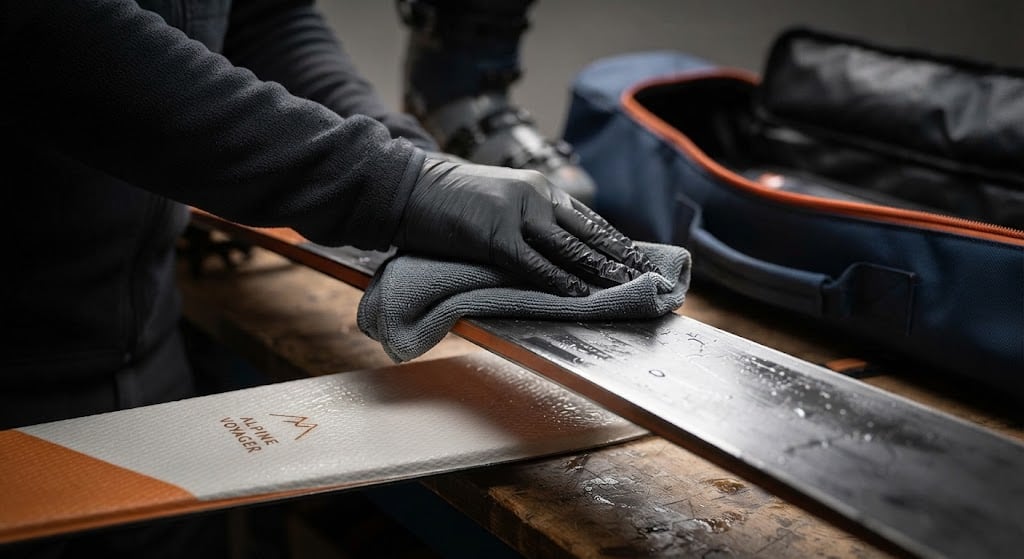
- Dry the edges and base with a cloth. Thirty seconds.
- Let the gear air dry at home, standing or leaning, before it goes in the bag.
- Store the bag open or not fully zipped if the gear might still be damp.
The same rule applies to boots: they dry outside the bag, with the liners open.
And if the gear is going to be stored for a long time — the summer, or simply several weeks unused — there's one more step worth taking: cover the edges with a coat of wax and leave it unscraped. The wax acts as a barrier against ambient moisture and is the simplest way to stop rust appearing while the board or skis sit idle. It comes off when you start using them again.
Storing out of season
If the gear is going to sit unused for months:
- Completely dry, for the reason above.
- Somewhere cool and dry, not a storage room that heats up or next to a radiator.
- Lying flat or standing, but with no weight on it and not propped in a way that forces it.
- With ski bindings released, so the springs don't spend the summer compressed.
- And with storage wax on the base if you want to do it properly: a thick coat left unscraped protects the base and edges, and comes off at the start of the season.
Before you buy: a quick checklist
- If you rent your gear, you don't need a bag.
- Measure your gear and add 10-15 cm, no less and not much more.
- Padded if you fly; a soft bag is enough for the car.
- Check the empty bag's weight if you're tight on kilos for a flight.
- Room for boots only if you'll genuinely put them in: they take up a lot.
- Name and phone number inside and out.
- And the part that doesn't depend on the bag: never store your gear wet.
In the end, the most expensive bag on the market doesn't protect your gear half as well as the habit of drying it before putting it away. A decent padded bag, filled out with clothing and with dry gear inside, is all almost anyone needs.