
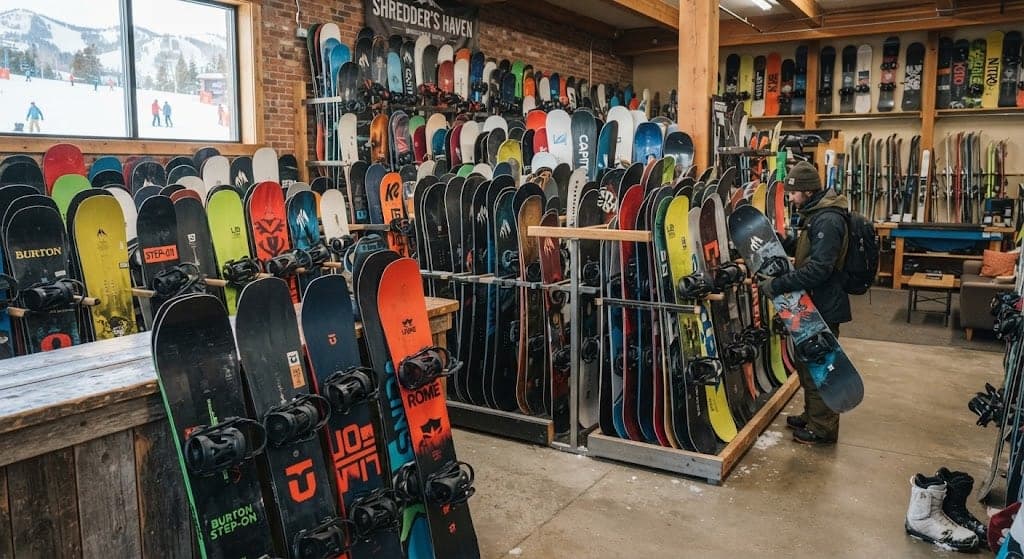

The board is the heart of snowboarding. Its length, width, flex, profile and shape determine how the energy you put through your legs is transmitted, how stable you are in each turn, and that feeling of flow — or of fighting — you get underfoot. This guide goes through each of those characteristics, not so you can memorise a spec sheet, but so you know two things: which board you need now and, almost more importantly, when your board has started holding your progression back.
In short: your weight sets the size, not your height; check that your boot doesn't hang over the edge; and if you're starting out, soft flex (1-3), rocker or flat profile and a twin shape. Before you buy anything, rent for a season: until you know what kind of riding you enjoy, you don't know what board you want.
Before you buy: rent
Let's start with what you won't read in a shop.
If you've been riding less than a season, the sensible thing is to rent, and there are two solid reasons.
The first is that you don't yet know what kind of rider you'll be. Park, piste, off-piste or a bit of everything are choices that determine the board, and you can't anticipate them before you've tried.
The second is that a beginner board runs out quickly. A soft, forgiving board is exactly what you need in the first days, and exactly what will limit you as soon as you carry speed. Plenty of people buy two boards in two years without needing to.
Renting lets you try different models, find out what you like, and buy once, properly. If you come to a lesson with us, ask us about the gear and we'll advise you based on what we see on the hill.
What size snowboard do I need?
It's the distance from the tip of the nose to the end of the tail.
The reference everyone repeats — that the board should reach somewhere between your chin and the tip of your nose — works as a first approximation. But what really matters is your weight, because the board works by deforming under your load: if you're light for the size you can't bend it and it won't turn; if you're heavy, it bends too much and you lose stability and grip.
Which is why every brand publishes a size chart with weight ranges for each model, and that's where to look.
| Your weight | Indicative length |
|---|---|
| 45 - 55 kg | ~145 cm |
| 56 - 67 kg | ~152 cm |
| 68 - 78 kg | ~157 cm |
| Over 80 kg | 160 cm or more |
It's indicative: every model has its own chart and they vary between brands and ranges. And within your weight range there are usually several possible sizes; from there it's personal preference:
- Shorter: more manoeuvrable, easier to turn, more agile and playful.
- Longer: more stable, faster and with more float in deep snow.
What board width do I need?
It's the distance from edge to edge through the centre of the board.
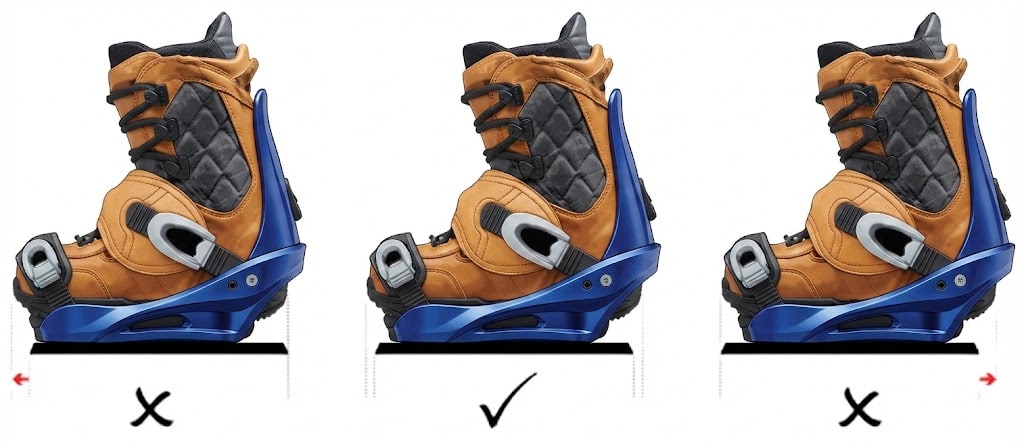
The waist width, in the middle of the board, has to match your boot size. If the boot hangs over too much, when you tilt the board to turn it will touch the snow before the edge does, and that costs you control and causes falls.
For larger sizes there are wide boards, with a greater width, and the threshold is usually from around 43-44 EU. But it also depends on the specific model and the angle you mount your bindings at, so the proper check is to mount your boot and look.
And be careful about overdoing it, because width affects two things at once: a narrow board changes edge faster but floats less; a wide one floats better in soft snow but is slower edge to edge.
Flex
It's the board's ability to deform under your pressure, and it isn't one thing: it's two.
- Longitudinal flex, along the board from nose to tail. It's what lets you tighten the radius of a turn and what generates pop, for example in an ollie.
- Torsional flex, the deformation around the longitudinal axis. It's what lets each foot apply different pressure, so the front and back of the board respond independently. It's talked about far less and it's decisive in how the board enters a turn.
From that comes the concept that sums up a board's character: responsiveness, which is how strongly and how quickly it returns to shape after being deformed. A stiff board has high responsiveness and returns the energy immediately and precisely. A soft one has low responsiveness: more comfortable and more forgiving, but with less response and less rebound.
What flex depends on
Flex isn't decided on a spec sheet: it comes out of the design and composition of the core, and of three specific factors.
Core thickness. Thicker means more stiffness and stability. Thinner means more flexibility and more sensitivity underfoot, because the board deforms under less pressure.
Construction, which is the least looked at and the most noticed:
- Sandwich: layers stacked horizontally. It gives more precision, more toughness and better energy transmission. It's what you want if you're after stability and control.
- Cap: the top sheet wraps over the sides of the board. Lighter and more flexible, it improves manoeuvrability and forgives mistakes more, in exchange for less precision and less lateral stiffness.
On top of that come elements like channels, sidewalls and lateral reinforcement, which directly influence how pressure is distributed as the board flexes and how the edge grips. A balanced structure transmits energy more smoothly and gives a more solid feeling of contact with the snow.
Core materials:
- Laminated woods, combined in different proportions according to the behaviour being sought: bamboo brings rebound and liveliness; paulownia, lightness and manoeuvrability; poplar and birch, stiffness and stability.
- Injected polyurethane foam: cheaper and lighter, but with less ability to recover and less durability. It gives a uniform, soft flex, which is why it's common in school boards and entry-level ranges.
And over the core go the reinforcements, which are layers, not cores:
- Fibreglass: the standard. Progressive flex, good toughness and a natural feel underfoot.
- Carbon: extremely stiff and reactive. It increases precision and immediate energy transmission.
- Kevlar: stands out for absorbing vibration, which brings stability on rough terrain or hard snow.
The combination and the orientation of those materials is what ultimately defines a board's character.
Flex ratings
It's normally classified on a scale of 1 to 10, where 1 is maximum flexibility and 10 maximum stiffness.
| Flex | Behaviour | Who it's for |
|---|---|---|
| 1 - 3 · Soft | Deforms under little pressure. Smooth and forgiving. | Beginners, park, jibbing, gentle terrain. |
| 4 - 6 · Medium | Holds the edge firmly without demanding technique. | Intermediate and versatile riders. Almost any terrain. |
| 7 - 10 · Stiff | Firm under pressure, immediate response. | Carving, speed and hard snow. |
Soft is very easy to handle and very playful, but it loses stability and tends to skid in tight turns or at speed, so it isn't the board for technical carving or demanding conditions.
Stiff offers precision and complete control, but it demands refined technique. And there's an important nuance people miss: it also isn't for riders who are light or don't have much leg strength, however good their level, because they simply won't manage to bend it.
Two more warnings. The scale isn't standardised: a 5 from one brand isn't a 5 from another, so it only works for comparing within a single catalogue. And flex loses stiffness with use, so a board that's several seasons old no longer behaves or feels like it did on day one.
The base
It's the surface in direct contact with the snow, and how it's made determines two things: how well it slides and how much maintenance it will ask of you.
Extruded base. Made by melting and moulding low-density polyethylene. It's simpler and cheaper to produce, very easy to repair after scratches and knocks, and doesn't hold wax well, which translates into less speed. It's the option for anyone who doesn't want to bother with maintenance.
Sintered base. Made from polyethylene powder compressed at high pressure and temperature. Its porous structure absorbs wax far better, so it slides more and holds it longer, but it needs waxing regularly to keep its properties: without wax it dries out and ends up sliding worse than a well-kept extruded base.
Put another way: sintered is only better if you're going to wax it. If you know you won't, extruded is the right choice and it saves you money too.
The shape
It's the outline you see looking at the board from above: the silhouette it draws from nose to tail.
The figure that sums it up is the sidecut dimensions, that is, the width at the nose, waist and tail. Looking at those three measurements you can get a sense of the board's turn radius before you even step on it.
And over that silhouette there are two concepts that appear on spec sheets:
- Symmetry: the waist sits centred on the board and the sidecut is the same on both edges.
- Longitudinal asymmetry: the waist sits further back from centre.
- Lateral asymmetry: the sidecut differs between the heel edge and the toe edge, to compensate for the fact that your body doesn't work the same way in each direction.
All of this directly influences behaviour on snow, the intended direction of travel, and how versatile the board is.
Types of board
Combining shape and profile gives you three families.
Twin (or true twin). Completely symmetrical: nose and tail identical in length, width and shape, and with the same flex in both halves. That lets you ride regular or switch interchangeably. It's the freestyle and park shape, and also an excellent option to start on, because you can experiment without worrying about direction. In exchange it performs slightly less well in carving and technical turns, where symmetry offers less stability and precision.
Directional. The nose is longer, wider or more raised than the tail, which tells you it's designed to travel one way. It offers more float in powder, better stability at speed and a firmer entry onto the front edge. It's the choice for freeride, fast pistes and high-performance carving: in a turn it gives a cleaner entry, better edge support and a more solid response in long or heavily angled turns.
Directional twin. It keeps almost total symmetry in the flex but with a nose that's slightly longer or differently shaped. It behaves well switch and performs best in the main direction. It's the most versatile option: compared with a true twin it's more stable at speed, and compared with a pure directional it leaves more freedom to play and manoeuvre.
The profile
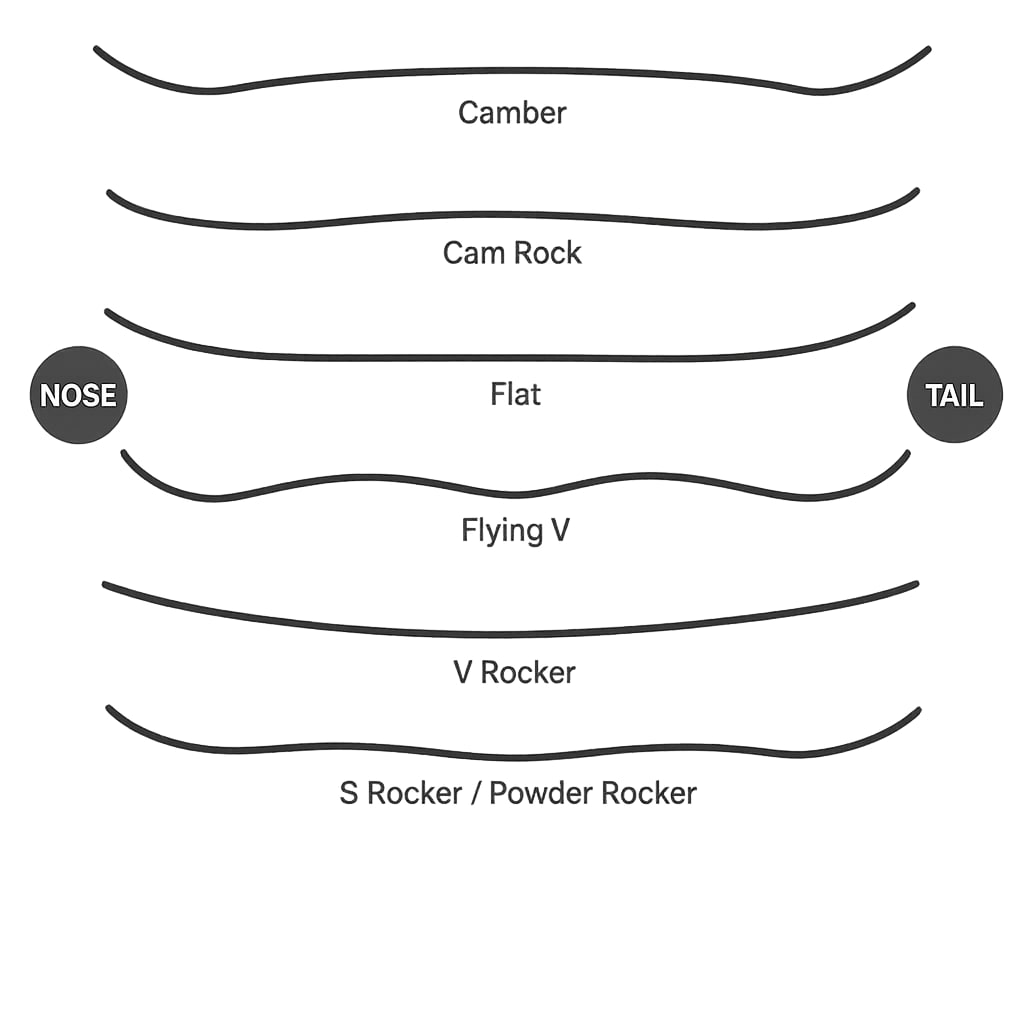
It's the shape of the board seen from the side, and it determines how it makes contact with the snow. Grip, float in powder, stability and ease of handling all depend on it.
| Profile | Grip and pop | Float | Forgives mistakes |
|---|---|---|---|
| Traditional camber | A lot | Little | Little |
| Inverted camber (rocker) | Little | A lot | A lot |
| Flat | Medium | Medium | Fairly |
| Hybrid | Fairly | Fairly | Fairly |
Traditional camber. The board touches the ground only at nose and tail, with the centre raised. It gives maximum edge grip, powerful pop and a lot of responsiveness, and it's very stable at speed. It's the choice for carving, for gripping on difficult terrain and for anyone after power. In exchange it's less forgiving and floats poorly in deep snow.
Inverted camber or rocker. The centre touches the ground and the nose and tail are raised. It's very forgiving of mistakes, easy to turn and floats very well in powder, but it loses grip and stability at speed. Good for relaxed freestyle, for beginners and for powder.
Flat camber. The board rests fully between nose and tail. A balance between grip and manoeuvrability: stable, though without camber's responsiveness, and it adapts well to bumps in the terrain. It's the all-mountain option for anyone after versatility without complications.
Hybrid camber. It combines camber, rocker and flat in different zones and proportions. The most common configurations are camber underfoot with rocker at the centre, nose and tail — precision and stability with more float; flat in the centre with rocker at the ends — versatile and forgiving; or central camber with rocker at nose and tail — reactive and stable, but more playful and easier in powder. It's what most boards use today.
If you're starting out, rocker or flat. And expect that as soon as you have control you'll want something with camber: that's the moment to buy properly.
Turn radius
It tells you how tight or how wide the curve you can draw with your board will be.
When you look at it from above you'll see the edge doesn't follow a straight line: it has a slight curvature, the one drawn by the sidecut. If you extended that curve until it closed completely, you'd get an imaginary circle, and the size of that circle is the turn radius. Think of it as the board "wanting" to follow that curve every time you set the edge.
| Radius | Behaviour |
|---|---|
| 7 - 9 m · short | Tight, reactive, quick turns. Narrow pistes, busy areas and technical riding. Very useful if you want agility. |
| 10 - 14 m · long | Wide, stable, flowing turns. Carving, speed and long curves, with more feeling of control at speed. |
A short radius can end up feeling too reactive, which is ideal for aggressive turns at low speed. A long one lets you keep the edge set for longer, draw cleaner lines and make the most of the centrifugal force of each turn.
The edges
They're the metal strips running along the board from nose to tail. Their job is to bite into the snow when you tilt the board, letting you turn with control and steer it.
The part of the edge that makes contact with the snow is called the effective edge, and the longer it is, the more grip you have. Which is why two boards of the same length can behave very differently: a pronounced rocker reduces the effective edge even though the board measures the same.
Edges should be sharp and free of debris. If they're worn or badly maintained, the board will tend to skid or behave unpredictably on hard snow, and you lose control and precision.
Each edge has two faces, and each is worked at its own angle:
Base edge, the underside, right where the base meets the metal. It softens or sharpens the board's initial behaviour as you start a turn.
- 0° (flat): the board bites into the snow immediately. It requires advanced technique, and suits carving and aggressive turns.
- 1°: more forgiving and easier to control. What suits anyone progressing or valuing comfort.
Side edge, the vertical face, perpendicular to the previous one. It influences how much traction the edge has once the board is already tilted.
- 90°: hard-wearing and easy to maintain. Good grip and less aggressive.
- 89°: a balance of traction and durability. The norm in all-mountain.
- 88°: maximum grip for hard snow and demanding conditions. Wears faster and asks for more maintenance.
And on edge design itself, there are three approaches:
- Traditional linear edge: continuous and smooth from nose to tail. Predictable, stable steering.
- Edge with localised contact points: slight bumps in the binding area, underfoot, that create a more marked pressure point exactly where it's most needed and considerably improve grip on hard snow.
- Edge with multiple contact points: bumps along the whole edge, with a kind of serrated effect that multiplies the contact points to maximise grip.
Maintenance
The condition of the edges and the base makes an enormous difference, and it comes down to four simple routines.
- Check the edges. Keep them sharp and clean, with no burrs or rust. If you notice them catching or losing grip, take the board to a workshop: a bad sharpening alters the edge angle and affects control.
- Wax regularly. Wax hydrates the base, improves glide and protects against abrasion. That means every 3 to 5 days of use, or sooner if the base looks dry or chalky.
- Repair the base. Knocks against rocks or ice leave scratches and cuts. If they're superficial, wax corrects them; if they're deep, use P-Tex or Cofix, or take it to a workshop.
- Store it properly at the end of the season. Clean it, dry it completely and apply a generous coat of wax without scraping it off, both on the base and over the edges, to protect them from rust. Loosen or remove the bindings and leave it somewhere dry, ventilated and with no weight on it.
The detail of tools, angles and procedure is worth a guide of its own, and we have one.
What to buy for your level
| Beginner | Intermediate | Advanced | |
|---|---|---|---|
| Flex | 1 - 3 | 4 - 6 | 6 - 10 |
| Profile | Rocker or flat | Hybrid or camber | Depends on discipline |
| Shape | Twin | Directional twin | Depends on discipline |
| Size | Lower end of your range | Within your range | Matched to use |
| Base | Extruded | Whichever you'll maintain | Sintered |
Buying second-hand
It can work out very well, and there are four things to check before you pay:
- The base, looking for deep cuts that reach the fibre, not superficial scratches.
- The edges, that they aren't rusted, notched or lifting anywhere.
- Delamination, which is what rules a board out: look at the edge in profile for layers separating, especially at nose and tail.
- The flex, which softens over the years. A heavily used board is no longer the board it was, however immaculate it looks from outside.
And check that the size and width suit you, which is the first thing forgotten when a bargain appears.
Before you buy: a quick checklist
- If you've been riding less than a season, rent. Seriously.
- Size by weight, checking the chart for the specific model.
- Test the width with your boot mounted; wide from around 43-44 EU.
- Flex 1-3, rocker or flat profile and a twin shape if you're starting out.
- Don't compare flex between brands: each rates it its own way.
- Extruded base unless you're going to wax every 3-5 days.
- Second-hand: base, edges, delamination and softened flex.
And the last idea, the one most often forgotten: the board can also be what's holding you back. If you notice you're skidding where you used to grip, that the board doesn't respond when you ask it to, or that it runs out as soon as you carry speed, it may not be your technique: it may be that you've outgrown the gear you started on. That's the moment to change, and not before.